The current through a diode is measured for a range of potential differences in both the forward and reverse bias.The current is very small when the diode is reverse biased and can only be measured using a milliammeter.A silicon diode conducts easily in its forward direction above a potential difference of about 0.6V and hardly at all below 0.6V or in the opposite direction.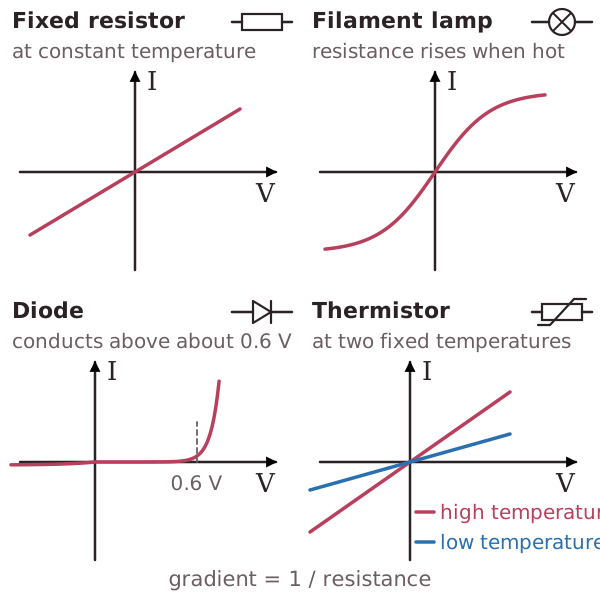 Diodes are made of two doped semiconductors.P-type semiconductor material has impurities that have too few conduction electrons.N-type semiconductors are made of silicon with an impuritiy that adds more conduction electrons.Electrons can flow from the n-type to p-type semiconductor but not the other way round.