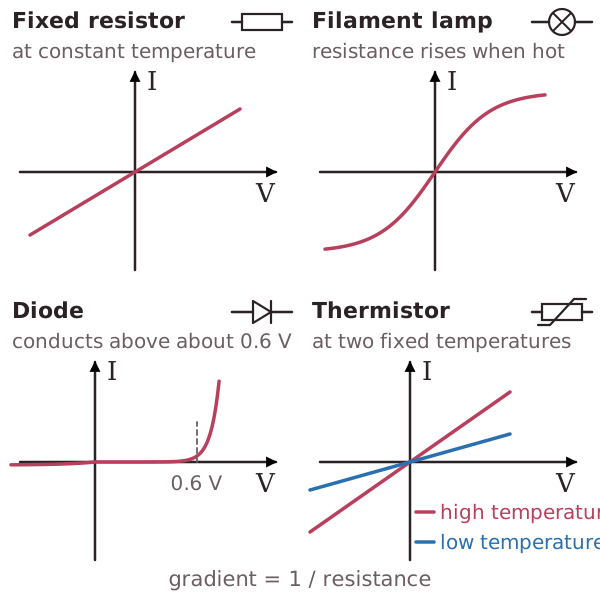
The I-V graph for a filament lamp is a non-linear, s-shaped curve passing through the origin, because the current is not directly proportional to potential difference.At low potential differences, the graph is a straight line through the origin.As the potential difference increases, the filament heats up, causing higher resistance and a decreasing gradient, which means the current increases at a slower rate.The IV graph of a filament lamp gives a curve with decreasing gradient because resistance increases as it gets hotter.This is because the metal ions vibrate more.Electrons collide with the ions more frequently and transfer some of their energy as heat energy to the surroundings.gradient = 1/resistance