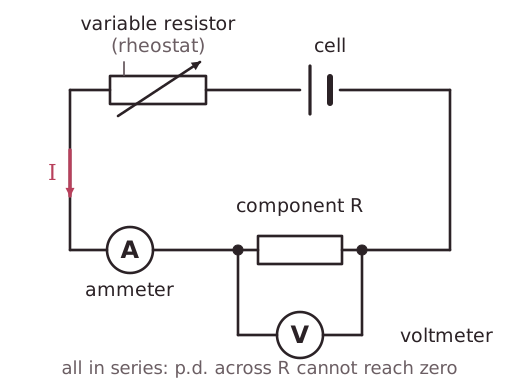
Many electronic components are used to control the current and potential difference in a circuit. The current through a component can be varied using either a variable resistor or a potential divider.A variable resistor (rheostat) is connected in series with the component. Changing its resistance changes the current, but the current and p.d. across the component can never be reduced to zero.
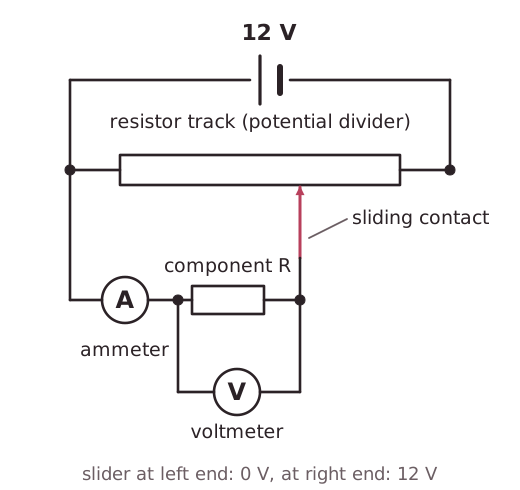
A potential divider, or potentiometer, is connected across the supply, with the component connected between the sliding contact and one end. Moving the slider varies the p.d. across the component continuously from zero up to the full supply voltage.
Other important components include the thermistor, whose resistance falls as its temperature rises, the light-dependent resistor (LDR), whose resistance falls as the light intensity increases, and the semiconductor diode, which lets current pass easily in one direction (forward bias) but hardly at all in the other (reverse bias).
Electronic Components
Read the text
Read the text and highlight anything you think is important. When you go on, the text is hidden and you answer from memory.
Specification: AQA Physics (7407), AS-level, 3.5.1.3 Resistivity and 3.5.1.1 Basics of electricity. Topic: Electric Current.
Key terms in this lesson
- Potential difference
- The energy transferred per unit charge as charge moves between two points in a circuit.
More in Electric Current
- Measuring Resistance
- Ohm's Law
- Resistivity
- Superconductivity
- Investigating the Characteristics of Components
- IV Graphs
- Fixed Resistors
- Filament Lamp
All 20 lessons in Electric Current · All AQA AS-level Physics topics