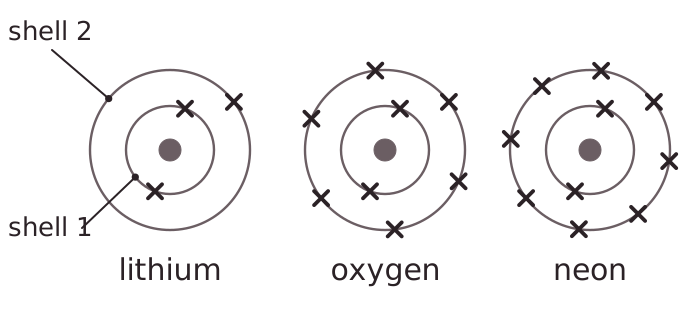
The electrons in an atom are arranged in shells (energy levels) around the nucleus. Electrons always fill the innermost shell first. For the first 20 elements, the first shell holds a maximum of 2 electrons, the second shell holds a maximum of 8 and the third shell holds a maximum of 8. The fourth shell only begins to fill after the third shell has 8.
The electronic configuration of an atom lists the number of electrons in each shell, starting from the innermost, with a dot between each number. A neutral atom has the same number of electrons as its atomic number. Sodium has 11 electrons: 2 in the first shell, 8 in the second and 1 in the third, so its configuration is 2.8.1. Chlorine has 17 electrons, so it is 2.8.7. Argon has 18 electrons, so it is 2.8.8.
Potassium has 19 electrons. The first three shells are full (2.8.8), so the nineteenth electron goes in the fourth shell and potassium is 2.8.8.1. Calcium has 20 electrons and is 2.8.8.2. In a diagram, each shell is drawn as a circle around the nucleus and the electrons are drawn on the circles as dots or crosses.