Ionic bonding happens between a metal and a non-metal. The metal atoms transfer electrons to the non-metal atoms. An atom that loses electrons becomes a positively charged ion called a cation. An atom that gains electrons becomes a negatively charged ion called an anion. Atoms transfer electrons so that each ion ends up with a full outer shell, like the nearest noble gas.
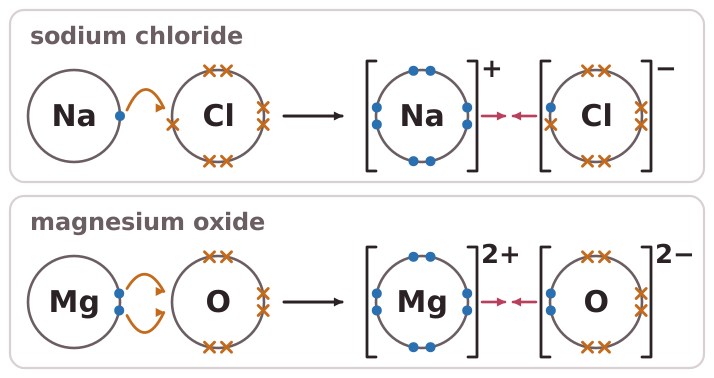
Sodium (2.8.1) reacts with chlorine (2.8.7). The sodium atom transfers its one outer electron to the chlorine atom. The sodium ion has the configuration 2.8 and is positive, because it has one more proton than electrons. The chlorine atom gains the electron to become 2.8.8, a negative chloride ion. The oppositely charged ions attract each other very strongly. This electrostatic attraction is the ionic bond.
In a dot and cross diagram, the outer electrons of one atom are drawn as dots and those of the other atom as crosses. After the transfer, each ion is drawn in square brackets with its charge shown at the top right, and the outer shell is full. In magnesium oxide, each magnesium atom transfers two electrons to an oxygen atom, forming a magnesium ion with a 2+ charge and an oxide ion with a 2- charge.