In 1869 the Russian chemist Dmitri Mendeleev set out to bring order to the elements known at that time. He listed them in order of increasing atomic mass (now called relative atomic mass). Then he looked for patterns in how the elements behaved.
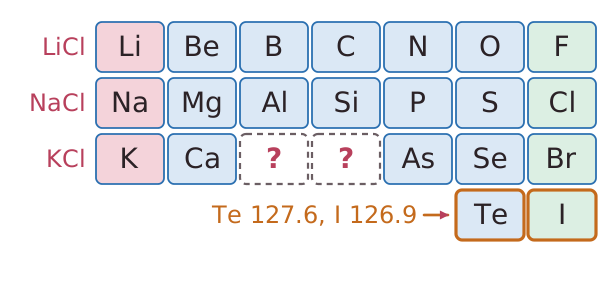
Mendeleev compared the physical and chemical properties of the elements, and also the formulae and reactions of their compounds, such as their oxides and chlorides. For example, the chlorides of lithium, sodium and potassium have similar formulae, LiCl, NaCl and KCl, and the three metals react in similar ways. So he put them in the same vertical column.
When the pattern of properties began to repeat, he started a new row. This is why his table is called periodic. Sometimes the properties mattered more than the order of atomic mass. Iodine has a slightly lower atomic mass than tellurium, yet he placed iodine after tellurium, in a column with chlorine and bromine, because iodine behaves like those elements.