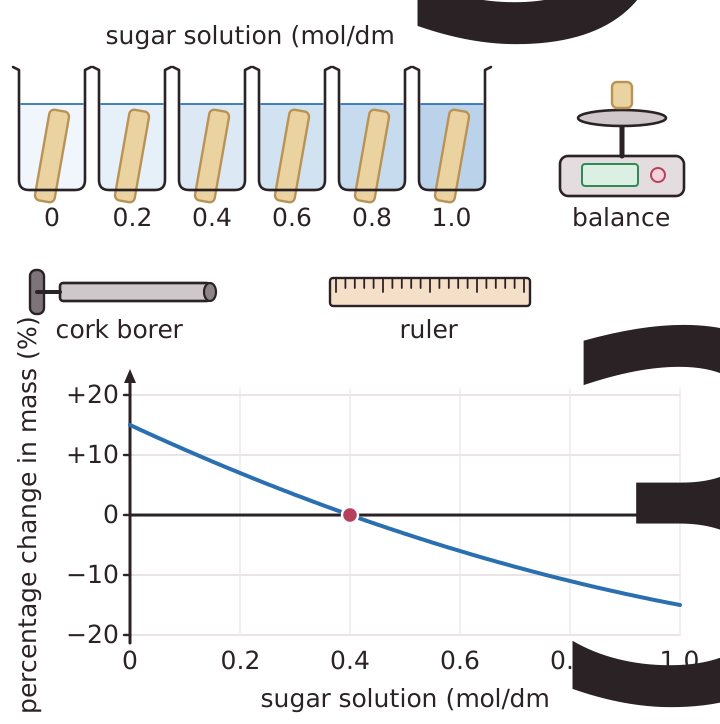
Osmosis is the movement of water from a dilute solution to a more concentrated solution through a partially permeable membrane. Potato cells have this kind of membrane, so we can use potato to see which way water moves.
Use a cork borer to cut potato cylinders of the same diameter and trim them to the same length. Blot each cylinder with a paper towel, measure its initial mass and place each one in a different sugar solution, from pure water up to a strong sugar solution (for example 0, 0.2, 0.4, 0.6, 0.8 and 1.0 mol/dm3). Leave them for the same time, such as 30 minutes, at the same temperature. Then remove each cylinder, blot it dry with a paper towel to remove surface water and measure the final mass.
In pure water, the potato cells are more concentrated than the water, so water moves into the cells by osmosis and the cylinder gains mass. In a strong sugar solution, water moves out of the cells and the cylinder loses mass. Use: percentage change = (final mass − initial mass) ÷ initial mass × 100. A cylinder that goes from 4.0 g to 4.6 g gains 0.6 g, which is a 15% gain. A negative answer means a loss. If you plot percentage change against concentration, the line crosses the x-axis where there is no overall movement of water, so the solution has the same concentration as the potato cells.