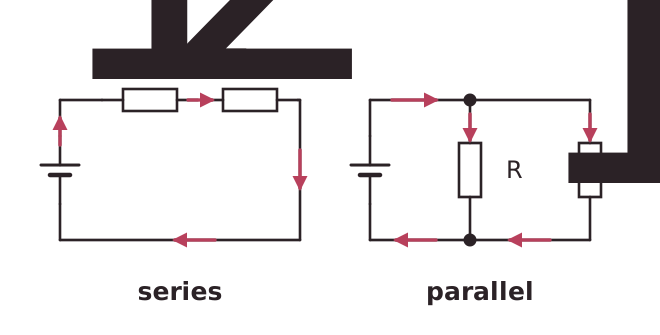
When two resistors are connected in series, all the charge has to pass through the first resistor and then through the second. Each one opposes the flow, so the total resistance is found by adding them: Rtotal = R1 + R2. The net resistance is greater than either resistor on its own. A 2 Ω and a 4 Ω resistor in series give 6 Ω, and 3 Ω in series with 5 Ω gives 3 + 5 = 8 Ω.
In a parallel connection the charge has more than one path to take. For the same potential difference, current flows through both branches, so the total current from the cell is larger than it would be with one resistor. A larger current for the same potential difference means the net resistance is less. The total resistance is always less than the smallest resistor in the parallel arrangement.
Two identical 10 Ω resistors in parallel give a net resistance of 5 Ω, which is half of one resistor. Adding a resistor in series increases the total resistance, but adding a resistor in parallel decreases it. In a series circuit there is only one path, so the total resistance increases when more resistors are added.