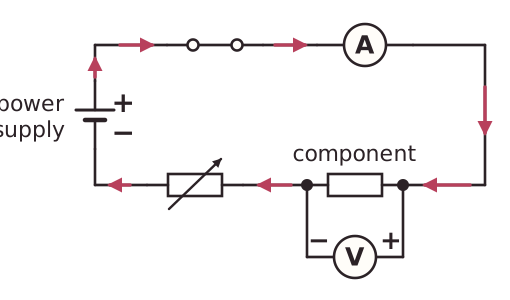
Aim: to investigate how the current in a fixed resistor and in a filament lamp depends on the potential difference across it. Build a series circuit of a power supply, a switch, an ammeter, the component and a variable resistor, with a voltmeter in parallel across the component. Start with the fixed resistor.
The independent variable is the potential difference across the component, which you change with the variable resistor or the supply setting. The dependent variable is the current, read from the ammeter. Take at least six pairs of readings, switching off between readings so the component stays at the same temperature. Then repeat for the filament lamp. Calculate R = V ÷ I for each pair and plot a graph of current against potential difference.
For the fixed resistor the graph is a straight line through the origin. The current is directly proportional to the potential difference, so the resistance is constant. For example, 0.20 A at 2.0 V gives 10 Ω, and the current doubles to 0.40 A at 4.0 V. For the filament lamp, the line curves because the filament gets hotter as the current rises, so its resistance increases. The same circuit idea can be used for part (b), testing series and parallel circuits with resistors and lamps by measuring the current and potential difference.