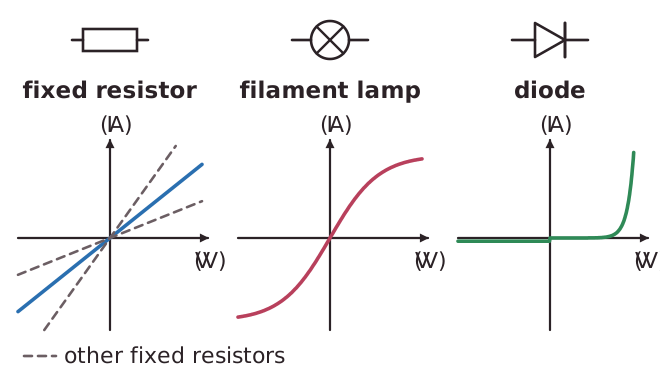
A fixed resistor has a constant resistance if its temperature stays the same. Its graph of current against potential difference is a straight line through the origin, and it is the same shape for both directions of current. A steeper line means a lower resistance, because more current flows for each volt.
A filament lamp gives a curve, so the line curves rather than staying straight. As the current increases, the filament gets hotter, the ions in the metal vibrate more and electrons collide with them more often. The resistance increases, so the line gets shallower at higher potential differences. The curve is symmetrical for both directions of current. Where the line is shallower the resistance is higher.
A diode conducts in the forward direction only. In the reverse direction its resistance is very high, so the current is almost zero. In the forward direction there is hardly any current for small potential differences, then the current rises steeply as the resistance falls. At any point on any graph, the resistance can be found from R = V ÷ I.