The rate of reaction is the change in the amount or concentration of a reactant or product per unit time.rate = change in concentration ÷ time taken When concentration is in mol dm-3 and time is in seconds, the units of rate are mol dm-3 s-1. Other units are used when a different quantity is followed, for example cm3 s-1 for a volume of gas or g s-1 for a loss in mass.Following a reactionTo measure a rate, you follow a property that changes during the reaction, such as:
the volume of gas given off (collected in a gas syringe)
the loss in mass as a gas escapes
a change in colour (measured with a colorimeter)
a change in pH or electrical conductivity.Rate from a graphA graph of concentration (or volume, or mass) against time is usually steepest at the start and levels off as the reactants are used up. The rate at any moment is the gradient of the tangent to the curve at that time. The rate at t = 0 is the initial rate.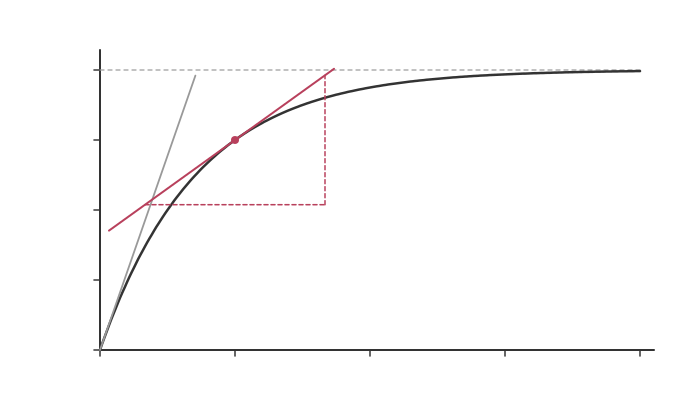
mean rate = 60 ÷ 30 = 2.0 cm3 s-1 This is a mean rate over 30 s. As the acid is used up the reaction slows down, so the rate at 30 s is lower than the initial rate.
the volume of gas given off (collected in a gas syringe)
the loss in mass as a gas escapes
a change in colour (measured with a colorimeter)
a change in pH or electrical conductivity.Rate from a graphA graph of concentration (or volume, or mass) against time is usually steepest at the start and levels off as the reactants are used up. The rate at any moment is the gradient of the tangent to the curve at that time. The rate at t = 0 is the initial rate.