Collision theory explains why reactions happen and what controls their rate.For particles to react, they must collide. In a gas at room temperature each particle collides with others billions of times every second. If every collision caused a reaction, all reactions would be almost instant. In fact only a tiny fraction of collisions lead to a reaction.A collision is successful (leads to a reaction) only if two conditions are met.1. Enough energy. The colliding particles must have energy equal to or greater than the activation energy, Ea. This energy is needed to start breaking bonds. In a collision with less energy than Ea, the particles just bounce apart unchanged.2. Correct orientation. The particles must meet the right way round, so that the reacting parts of each particle come into contact. A collision between the wrong parts of two molecules does not lead to a reaction, however energetic it is.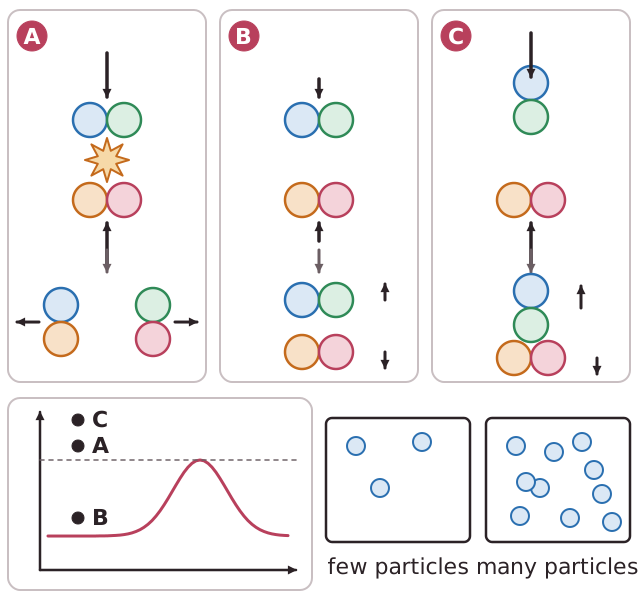 The rate of reaction therefore depends on the frequency of successful collisions, that is, the number of successful collisions per second. Anything that increases this frequency increases the rate.There are two ways to do this:
make collisions happen more often (more collisions per second), or
make a larger proportion of the collisions successful (more with energy ≥ Ea).These two ideas are used to explain how concentration, pressure, surface area, temperature and catalysts affect the rate of a reaction.
The rate of reaction therefore depends on the frequency of successful collisions, that is, the number of successful collisions per second. Anything that increases this frequency increases the rate.There are two ways to do this:make collisions happen more often (more collisions per second), or
make a larger proportion of the collisions successful (more with energy ≥ Ea).These two ideas are used to explain how concentration, pressure, surface area, temperature and catalysts affect the rate of a reaction.