Increasing the temperature increases the rate of reaction, often by a large amount. For many reactions, a rise of about 10 °C roughly doubles the rate.At a higher temperature the molecules have more kinetic energy on average. The Maxwell-Boltzmann distribution changes shape: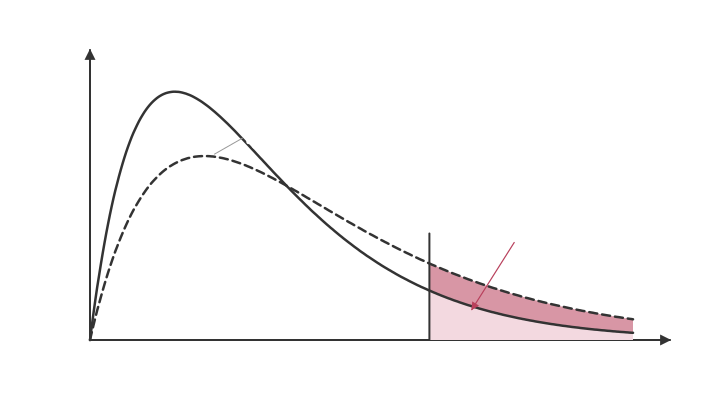
• The curve is broader, with more molecules at high energy.
• The area under the curve is unchanged, because the number of molecules is the same.The activation energy does not change. However, at the higher temperature a much larger area lies to the right of Ea, so a much larger proportion of molecules have energy greater than or equal to Ea. More of the collisions are successful, so there are more successful collisions per unit time.The molecules also move faster, so they collide slightly more often. This effect is small. The main reason for the increase in rate is the greater proportion of collisions with energy ≥ Ea.Exam tip: when you draw the higher-temperature curve, start it at the origin, make its peak lower and further right, keep it above the original curve at high energy, and do not let it cross the x-axis.