Collision theory says that particles must collide with the correct orientation to react. For small particles this is fairly easy, but in larger organic molecules the reacting part may be partly hidden.Steric hindrance is the slowing of a reaction because bulky groups of atoms around the reactive site physically get in the way of an approaching particle.The bulky groups are usually alkyl groups, such as methyl (-CH3) or larger. They take up space and block some of the directions from which an attacking particle could reach the reactive atom.Effect on rateSteric hindrance reduces the proportion of collisions that have the correct orientation. Fewer collisions are successful, so the frequency of successful collisions falls and the reaction is slower. Even particles with more than enough energy may fail to react, because they cannot reach the reactive atom.ExampleWhen a hydroxide ion reacts directly with a halogenoalkane, it attacks the carbon atom bonded to the halogen, approaching from the side opposite the halogen atom.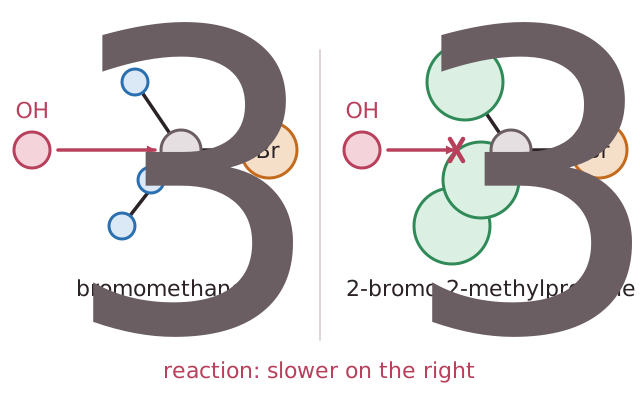 In bromomethane, CH3Br, this carbon carries only small hydrogen atoms, so the hydroxide ion can reach it easily.In 2-bromo-2-methylpropane, (CH3)3CBr, the same carbon is surrounded by three methyl groups. They crowd the back of the carbon atom, so a direct attack there is strongly hindered.In general, the more and the larger the groups around a reactive site, the greater the steric hindrance, and the slower any reaction that needs a particle to reach that site.