When one reactant is a solid, the reaction can only happen at its surface, because only the particles on the surface can collide with particles of the other reactant.Breaking a solid into smaller pieces, or grinding it into a powder, increases its surface area for the same mass. More particles are exposed, so there are more collisions per unit time and more successful collisions per unit time, and the rate increases.For example, calcium carbonate powder reacts much faster with dilute hydrochloric acid than the same mass of marble chips:CaCO3(s) + 2HCl(aq) → CaCl2(aq) + H2O(l) + CO2(g) If the acid is in excess, the total volume of carbon dioxide at the end is the same for both, because the same mass of calcium carbonate reacts. Only the time taken changes.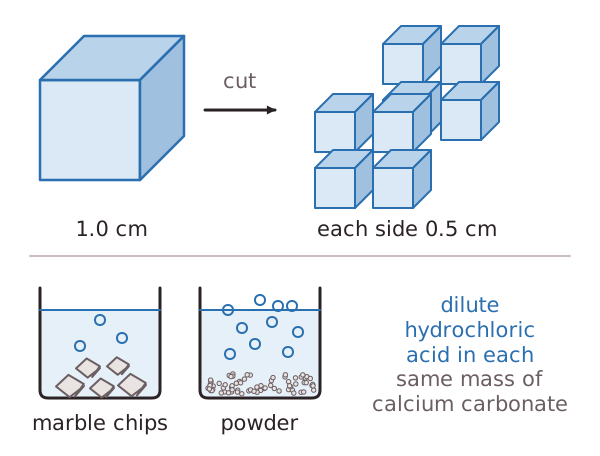 Worked example. A cube of side 1.0 cm has a surface area of 6 × (1.0 cm)2 = 6.0 cm2. Cut it into 8 cubes of side 0.5 cm. Each has a surface area of 6 × (0.5 cm)2 = 1.5 cm2, so the total is 8 × 1.5 = 12 cm2. The surface area has doubled, although the mass is the same.Very fine powders of combustible materials, such as flour or coal dust, have such a large surface area that they can burn explosively in air. This is also why solid catalysts are used as fine powders, gauzes or thin coatings: a larger surface area gives more places for the reaction to happen.