The activation energy, Ea, is the minimum energy that colliding particles must have for a reaction to occur.Even exothermic reactions need an input of energy to get started, because bonds in the reactants must begin to break before new bonds can form. This is why methane does not burn in air until a spark or flame is applied.Reaction profilesA reaction profile shows the enthalpy of the reactants and products and the energy barrier between them. The highest point is the transition state, where old bonds are partly broken and new bonds partly formed.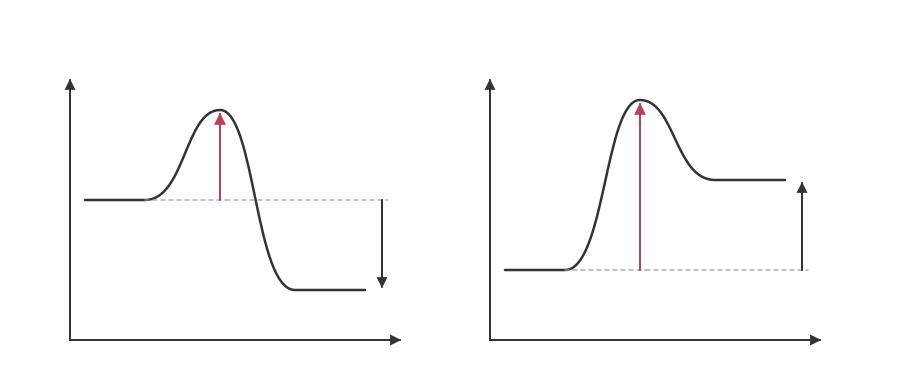
Ea(reverse) = 75 + 40 = +115 kJ mol-1 Effect on rateThe larger the activation energy, the smaller the proportion of collisions with enough energy to react, so the slower the reaction at a given temperature.