 BRAINCAKE
Graphite
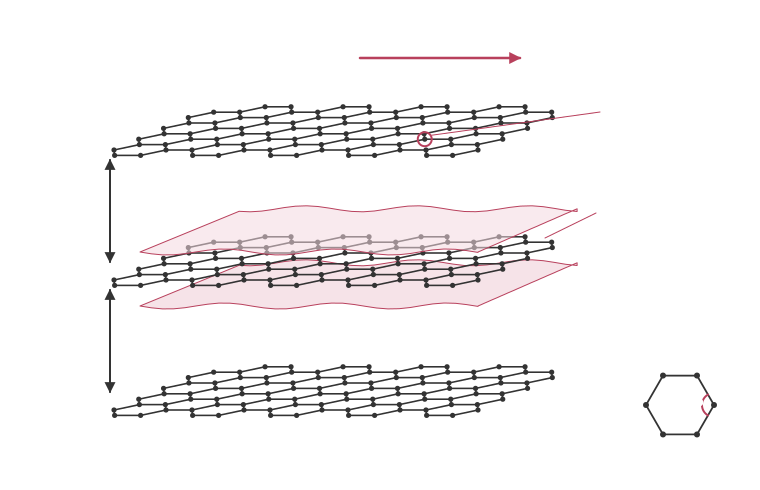
In graphite, each carbon atom forms three sigma bonds to 3 other carbon atoms forming interlocking hexagonal rings with bond angles 120°. The fourth electron is in a p orbital and p orbitals of adjacent carbon atoms are close enough to overlap and produce a cloud of delocalised electrons above and below the plane of the rings. Graphite is a solid lubricant as the layers can slide over each other easily and there are weak London forces between the layers. The lubricating properties are also helped by adsorbed gases on the surface of the carbon atoms.
Sign in free to see the rest of this lesson, the R.E.C.I.P.E. recall steps and the quiz
BrainCake is free. Make an account in seconds and pick up where this page stops.
Key terms in this lesson
- giant covalent lattice
- A structure in which atoms are joined to several neighbours by strong covalent bonds extending throughout the whole solid.
- delocalised electrons
- Electrons that are free to move throughout a structure rather than being fixed between two particular atoms.
More in Discrete Molecules
- Dissolving Ionic Solids
- Metallic Lattices
- Giant Ionic Lattices
- Giant Covalent Lattices
- Diamond
- Graphene
- Molecular Lattices
- Structure and Bonding Question
All 25 lessons in Discrete Molecules · All Edexcel AS-level Chemistry topics