Recrystallisation purifies an impure organic solid. It works because the product and the impurities have different solubilities in a chosen solvent.A suitable solvent dissolves the product well when hot but poorly when cold. Soluble impurities, present in small amounts, stay dissolved when the solution cools.Method:1. Dissolve the impure solid in the minimum volume of hot solvent, so that the solution is saturated.
2. If there are insoluble impurities, filter the hot solution quickly (hot filtration) to remove them.
3. Leave the solution to cool slowly. The product becomes less soluble and crystallises out; the soluble impurities remain in solution.
4. Collect the crystals by filtration under reduced pressure.
5. Wash the crystals with a little cold solvent and leave them to dry.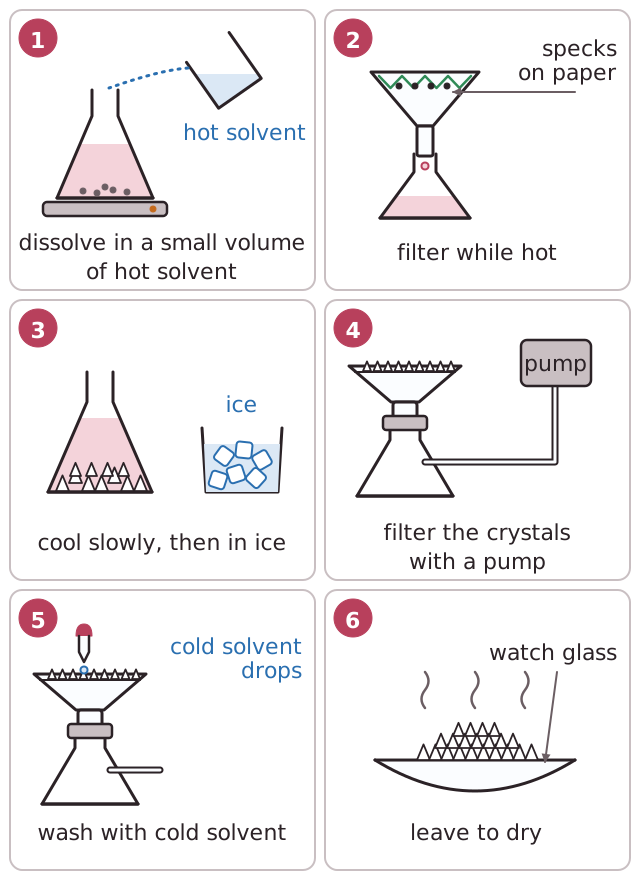 Why the minimum volume? If too much hot solvent is used, more product stays dissolved when the solution cools, so the yield is lower. It may even not crystallise at all.Slow cooling gives larger, purer crystals, because impurities are less likely to be trapped inside a crystal that grows slowly. Cooling in ice at the end increases the amount of crystals collected.Worked example: a crude sample of benzoic acid is recrystallised from water. 5.0 g of crude solid gives 3.8 g of pure crystals, so the percentage recovery is (3.8 ÷ 5.0) × 100 = 76%.
2. If there are insoluble impurities, filter the hot solution quickly (hot filtration) to remove them.
3. Leave the solution to cool slowly. The product becomes less soluble and crystallises out; the soluble impurities remain in solution.
4. Collect the crystals by filtration under reduced pressure.
5. Wash the crystals with a little cold solvent and leave them to dry.
Why the minimum volume? If too much hot solvent is used, more product stays dissolved when the solution cools, so the yield is lower. It may even not crystallise at all.Slow cooling gives larger, purer crystals, because impurities are less likely to be trapped inside a crystal that grows slowly. Cooling in ice at the end increases the amount of crystals collected.Worked example: a crude sample of benzoic acid is recrystallised from water. 5.0 g of crude solid gives 3.8 g of pure crystals, so the percentage recovery is (3.8 ÷ 5.0) × 100 = 76%.