Measuring the melting point of a solid is a quick test of its purity, and can help identify it.A pure substance melts at a sharp, fixed temperature, usually over a range of about 1 °C or less. An impure substance melts at a lower temperature and over a wider range of temperatures, because the impurities disrupt the regular lattice.Method:1. Make sure the sample is dry and finely powdered.
2. Seal one end of a thin capillary tube and push in a small amount of solid, about 2 to 3 mm deep.
3. Place the tube in melting point apparatus (an electrically heated block with a thermometer or digital reading), or attach it to a thermometer in an oil bath (a Thiele tube).
4. Heat slowly near the expected melting point, and record the temperature when the solid starts to melt and when it has completely melted.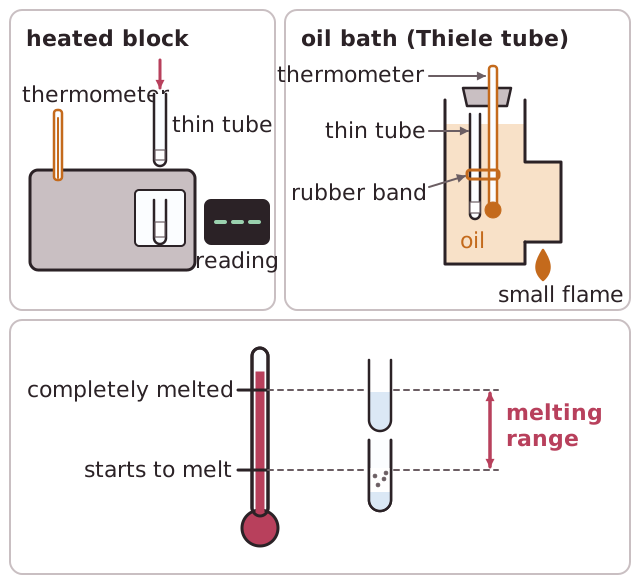 The measured range is compared with the data book value. A close match with a sharp range suggests the sample is the expected compound and is pure.Worked example: the data book melting point of benzoic acid is 122 °C. Sample X melts from 121 to 122 °C; sample Y melts from 114 to 119 °C. X is pure benzoic acid. Y is impure: its melting point is lower and its range is 5 °C wide, so it should be recrystallised again.Heating slowly matters: heating too fast makes the sample lag behind the thermometer, so the reading is too high.
2. Seal one end of a thin capillary tube and push in a small amount of solid, about 2 to 3 mm deep.
3. Place the tube in melting point apparatus (an electrically heated block with a thermometer or digital reading), or attach it to a thermometer in an oil bath (a Thiele tube).
4. Heat slowly near the expected melting point, and record the temperature when the solid starts to melt and when it has completely melted.
The measured range is compared with the data book value. A close match with a sharp range suggests the sample is the expected compound and is pure.Worked example: the data book melting point of benzoic acid is 122 °C. Sample X melts from 121 to 122 °C; sample Y melts from 114 to 119 °C. X is pure benzoic acid. Y is impure: its melting point is lower and its range is 5 °C wide, so it should be recrystallised again.Heating slowly matters: heating too fast makes the sample lag behind the thermometer, so the reading is too high.