An aliphatic synthetic route converts one non-aromatic compound into another in one or more steps. You need to recall the reagents and conditions linking the functional groups in the specification:• alkene → alcohol: steam, H3PO4 catalyst
• alkene → haloalkane: hydrogen halide (e.g. HBr) at room temperature
• alcohol → alkene: acid catalyst (conc. H3PO4 or H2SO4), heat
• alcohol → haloalkane: NaBr and conc. H2SO4 (forms HBr)
• haloalkane → alcohol: NaOH(aq), heat under reflux
• haloalkane → nitrile: KCN in ethanol (adds one carbon)
• haloalkane → amine: excess NH3 in ethanol
• primary alcohol → aldehyde: K2Cr2O7/H2SO4, distil
• primary alcohol → carboxylic acid: K2Cr2O7/H2SO4, heat under reflux
• secondary alcohol → ketone: K2Cr2O7/H2SO4, reflux
• aldehyde or ketone → alcohol: NaBH4
• carbonyl → hydroxynitrile: NaCN/H+ (adds one carbon)
• carboxylic acid + alcohol → ester: conc. H2SO4 catalyst, heat
• nitrile → carboxylic acid: dilute acid, heat; nitrile → amine: H2/Ni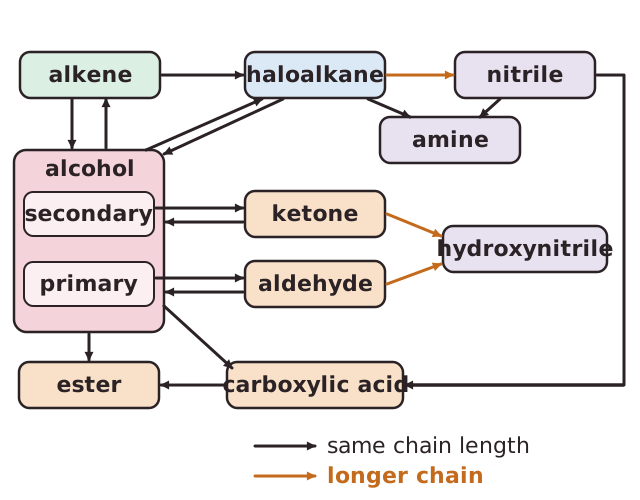 Worked example: convert propene into propanone.
Step 1: propene + steam with H3PO4 gives propan-2-ol (the major product).
Step 2: oxidise propan-2-ol with acidified dichromate under reflux to give propanone.Learn this as a map: most routes pass through the alcohol or the haloalkane.
• alkene → haloalkane: hydrogen halide (e.g. HBr) at room temperature
• alcohol → alkene: acid catalyst (conc. H3PO4 or H2SO4), heat
• alcohol → haloalkane: NaBr and conc. H2SO4 (forms HBr)
• haloalkane → alcohol: NaOH(aq), heat under reflux
• haloalkane → nitrile: KCN in ethanol (adds one carbon)
• haloalkane → amine: excess NH3 in ethanol
• primary alcohol → aldehyde: K2Cr2O7/H2SO4, distil
• primary alcohol → carboxylic acid: K2Cr2O7/H2SO4, heat under reflux
• secondary alcohol → ketone: K2Cr2O7/H2SO4, reflux
• aldehyde or ketone → alcohol: NaBH4
• carbonyl → hydroxynitrile: NaCN/H+ (adds one carbon)
• carboxylic acid + alcohol → ester: conc. H2SO4 catalyst, heat
• nitrile → carboxylic acid: dilute acid, heat; nitrile → amine: H2/Ni
Worked example: convert propene into propanone.Step 1: propene + steam with H3PO4 gives propan-2-ol (the major product).
Step 2: oxidise propan-2-ol with acidified dichromate under reflux to give propanone.Learn this as a map: most routes pass through the alcohol or the haloalkane.