Aromatic synthetic routes start from benzene or phenol. Benzene reacts by electrophilic substitution, so each step adds or changes a group on the ring. The key conversions are:• benzene → nitrobenzene: conc. HNO3 and conc. H2SO4, 50 °C
• nitrobenzene → phenylamine: tin and conc. HCl, heat under reflux, then NaOH(aq)
• benzene → bromobenzene: Br2 with a halogen carrier such as FeBr3 or AlBr3
• benzene → alkylbenzene: haloalkane and AlCl3 (Friedel-Crafts alkylation)
• benzene → aromatic ketone: acyl chloride and AlCl3 (Friedel-Crafts acylation)
• phenol → 2,4,6-tribromophenol: bromine water at room temperature, no halogen carrier
• phenol → nitrophenols: dilute HNO3 at room temperature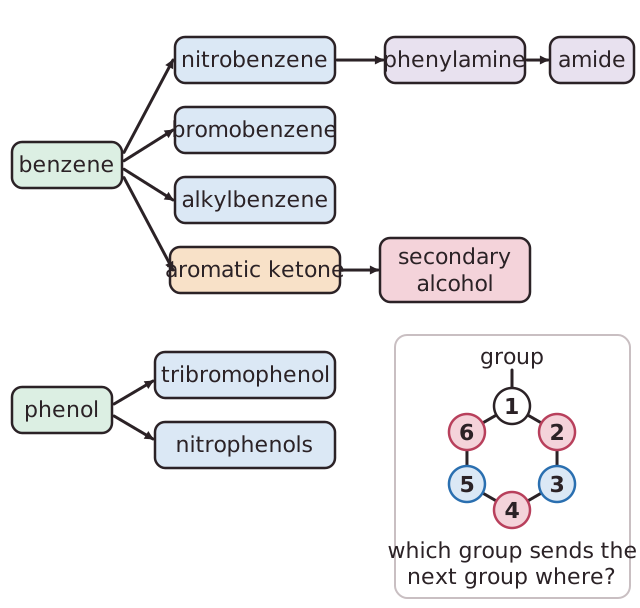 Groups already on the ring affect where the next group goes. OCR expects you to know that −OH and −NH2 are 2- and 4-directing and that −NO2 is 3-directing. So the order of the steps matters.Once on the ring, side groups react by aliphatic chemistry: an aromatic ketone can be reduced with NaBH4 to a secondary alcohol, and an aromatic amine can react with an acyl chloride to form an amide.Worked example: make 3-bromonitrobenzene from benzene.
Step 1: nitrate first (conc. HNO3/conc. H2SO4, 50 °C).
Step 2: brominate (Br2/FeBr3). The −NO2 group directs Br to position 3.
Brominating first would give mainly 2- and 4-products instead.
• nitrobenzene → phenylamine: tin and conc. HCl, heat under reflux, then NaOH(aq)
• benzene → bromobenzene: Br2 with a halogen carrier such as FeBr3 or AlBr3
• benzene → alkylbenzene: haloalkane and AlCl3 (Friedel-Crafts alkylation)
• benzene → aromatic ketone: acyl chloride and AlCl3 (Friedel-Crafts acylation)
• phenol → 2,4,6-tribromophenol: bromine water at room temperature, no halogen carrier
• phenol → nitrophenols: dilute HNO3 at room temperature
Groups already on the ring affect where the next group goes. OCR expects you to know that −OH and −NH2 are 2- and 4-directing and that −NO2 is 3-directing. So the order of the steps matters.Once on the ring, side groups react by aliphatic chemistry: an aromatic ketone can be reduced with NaBH4 to a secondary alcohol, and an aromatic amine can react with an acyl chloride to form an amide.Worked example: make 3-bromonitrobenzene from benzene.Step 1: nitrate first (conc. HNO3/conc. H2SO4, 50 °C).
Step 2: brominate (Br2/FeBr3). The −NO2 group directs Br to position 3.
Brominating first would give mainly 2- and 4-products instead.