Filtration under reduced pressure (also called vacuum or suction filtration) separates a solid from a liquid much faster than gravity filtration, and leaves the solid drier. It is used to collect a crude organic solid and, after recrystallisation, the purified crystals.The apparatus is a Büchner funnel (or a smaller Hirsch funnel) sitting in a Büchner flask, a thick-walled conical flask with a side arm. The side arm is connected by tubing to a vacuum pump or water aspirator: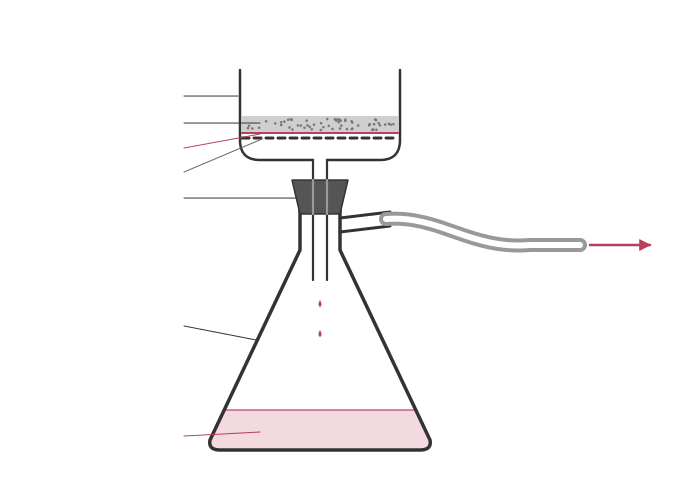
2. Wet the paper with a little of the solvent and switch on the vacuum so the paper seals to the funnel.
3. Pour the mixture into the funnel. The reduced pressure in the flask pulls the liquid (the filtrate) through, leaving the solid on the paper.
4. Rinse the solid with a small amount of cold solvent to wash away soluble impurities without dissolving much product.
5. Leave the vacuum on for a few minutes to draw air through and partly dry the solid.The flask is thick-walled because the pressure inside is lower than outside; ordinary thin glass could implode. Disconnect the tubing before turning off a water aspirator so water is not sucked back into the flask.Worked example: why wash with cold rather than hot solvent? The product is less soluble in cold solvent, so less of it is lost.