Quickfit apparatus is a set of glassware with standard ground-glass joints that fit tightly together, so no corks or bungs are needed and vapours cannot escape. The same flasks, condensers and still heads can be assembled in different ways.Heating under reflux is used when a reaction is slow and needs prolonged heating, e.g. oxidising a primary alcohol fully to a carboxylic acid. A round-bottomed (or pear-shaped) flask is fitted with a vertical Liebig condenser: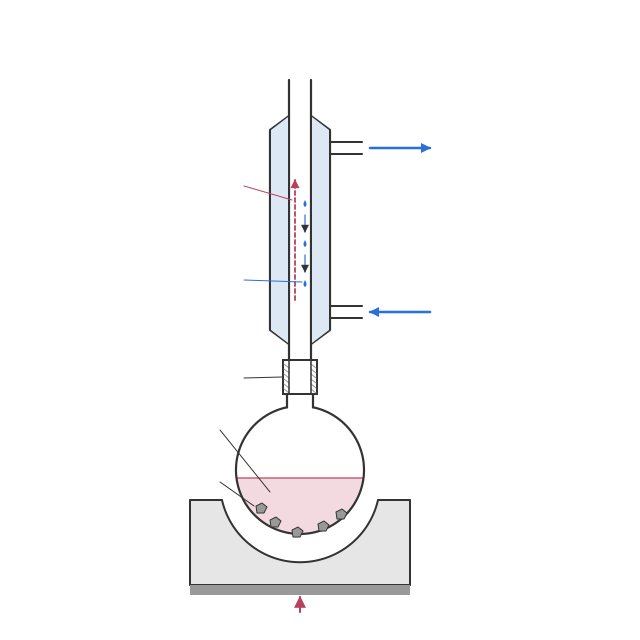
• the top of the condenser is left open: a sealed system would build up pressure
• anti-bumping granules give smooth boiling
• heat with an electric heating mantle or water bath, because organic liquids are flammableDistillation is used to separate a liquid from a mixture, or to remove a product as it forms, e.g. oxidising a primary alcohol to an aldehyde. The condenser is set at a slope leading to a collecting vessel, and a still head with a thermometer has its bulb level with the side arm, so it reads the boiling point of the vapour being collected.Worked example: a student wants ethanal, not ethanoic acid, from ethanol. Ethanal (b.p. 21 °C) is distilled off as soon as it forms, so it cannot be oxidised further.