Making an organic compound in the lab is only half the job: the crude product is always mixed with unreacted starting materials, by-products and solvent, so it must be purified and then its identity and purity checked.OCR expects you to know the practical techniques for:• carrying out the reaction: heating under reflux in Quickfit apparatus, so volatile reactants can be heated for a long time without escaping
• separating a liquid product: distillation, which also collects a volatile product as it forms; a separating funnel to remove an aqueous layer; drying with an anhydrous salt such as anhydrous MgSO4; and redistillation
• purifying a solid product: filtration under reduced pressure to collect the solid, and recrystallisation to remove soluble impurities
• checking purity: melting point determination for a solid (or boiling point for a liquid)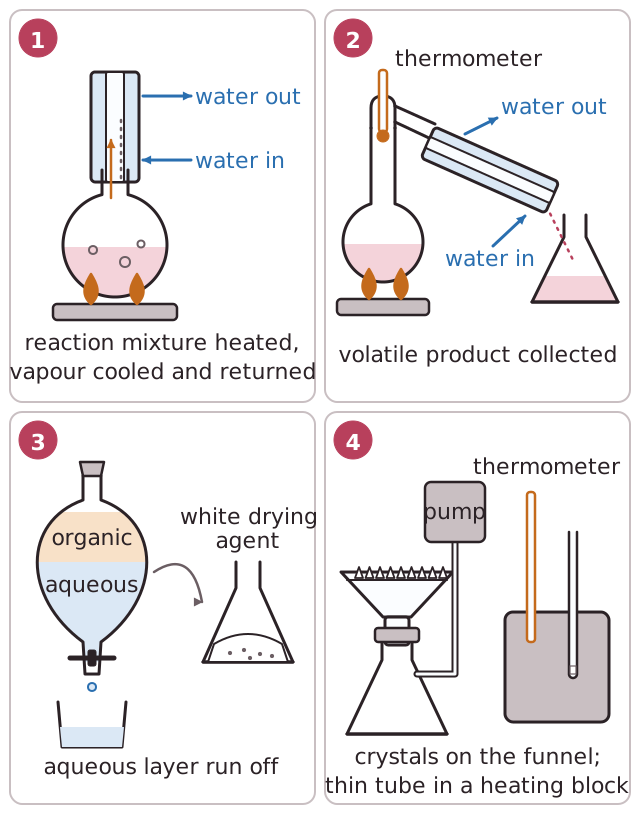 The choice depends on the state of the product. A liquid is usually separated by distillation; a solid is usually filtered, recrystallised and then its melting point measured.Worked example: aspirin is made as a crude solid. The sequence is: collect the solid by filtration under reduced pressure, recrystallise it from the minimum volume of hot solvent, filter again, dry, then measure the melting point and compare it with the data book value.Every purification step loses some product, so the percentage yield of a pure product is always lower than the yield of crude product.
• separating a liquid product: distillation, which also collects a volatile product as it forms; a separating funnel to remove an aqueous layer; drying with an anhydrous salt such as anhydrous MgSO4; and redistillation
• purifying a solid product: filtration under reduced pressure to collect the solid, and recrystallisation to remove soluble impurities
• checking purity: melting point determination for a solid (or boiling point for a liquid)
The choice depends on the state of the product. A liquid is usually separated by distillation; a solid is usually filtered, recrystallised and then its melting point measured.Worked example: aspirin is made as a crude solid. The sequence is: collect the solid by filtration under reduced pressure, recrystallise it from the minimum volume of hot solvent, filter again, dry, then measure the melting point and compare it with the data book value.Every purification step loses some product, so the percentage yield of a pure product is always lower than the yield of crude product.