Skip to content

Why Phenol is More Reactive than Benzene

Phenol, C6H5OH, reacts with bromine far more readily than benzene does. Benzene needs pure liquid bromine and a halogen carrier such as FeBr3, but phenol decolourises bromine water at room temperature with no catalyst at all.The difference comes from the oxygen atom of the OH group. One of the lone pairs on the oxygen overlaps with the delocalised π electrons of the ring, so this lone pair becomes partly delocalised into the ring. This increases the electron density of the ring, and the increase is greatest at the 2, 4 and 6 positions.
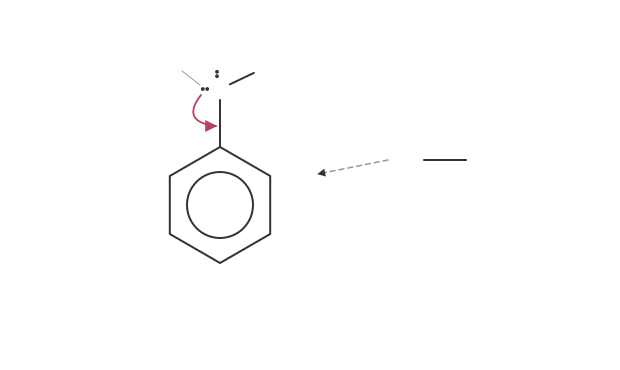
A ring with a higher electron density attracts electrophiles more strongly. It is also able to polarise a non-polar Br2 molecule: as a Br2 molecule approaches, the electron-rich ring repels the electrons in the Br-Br bond and induces a dipole. The δ+ bromine atom is then attacked by the ring directly. The ring in benzene is not electron-rich enough to do this, which is why benzene needs a halogen carrier to generate a Br+ electrophile.We say the OH group activates the ring towards electrophilic substitution. The effect is so strong that all three activated positions react, so phenol and excess bromine water give 2,4,6-tribromophenol as a white precipitate.The same reasoning explains why phenol can be nitrated by dilute nitric acid at room temperature, while benzene needs a mixture of concentrated nitric and sulfuric acids.

Read the text

Read the text and highlight anything you think is important. When you go on, the text is hidden and you answer from memory.