Friedel-Crafts acylation substitutes an acyl group, RCO, onto a benzene ring, producing an aromatic ketone. It is an electrophilic substitution.Reagents and conditions: an acyl chloride (e.g. ethanoyl chloride, CH3COCl) with an anhydrous aluminium chloride catalyst, heated under reflux in dry conditions.Generating the electrophile: AlCl3 removes the chlorine to form an acylium ion, RCO+:
CH3COCl + AlCl3 → CH3CO+ + AlCl4− Mechanism: a pair of electrons from the delocalised ring bonds to the positive carbon of CH3CO+, forming a positive intermediate. H+ is then lost from the carbon bonded to the acyl group, restoring the delocalised ring.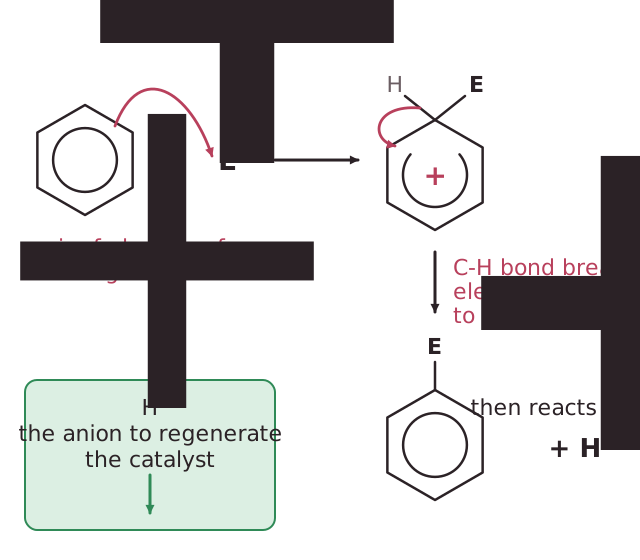 Regenerating the catalyst:
H+ + AlCl4− → AlCl3 + HCl Overall:
C6H6 + CH3COCl → C6H5COCH3 + HCl
The product is phenylethanone.Advantages over alkylation: the acyl group withdraws electron density from the ring, so the product is less reactive than benzene and only one group is added. The ketone can then be reduced or used in further reactions, which makes acylation a useful step in synthesis.Worked example: benzene reacts with propanoyl chloride, CH3CH2COCl, and AlCl3. The electrophile is CH3CH2CO+, and the products are C6H5COCH2CH3 (1-phenylpropan-1-one) and HCl.
Regenerating the catalyst:The product is phenylethanone.Advantages over alkylation: the acyl group withdraws electron density from the ring, so the product is less reactive than benzene and only one group is added. The ketone can then be reduced or used in further reactions, which makes acylation a useful step in synthesis.Worked example: benzene reacts with propanoyl chloride, CH3CH2COCl, and AlCl3. The electrophile is CH3CH2CO+, and the products are C6H5COCH2CH3 (1-phenylpropan-1-one) and HCl.