Phenol reacts rapidly with bromine water at room temperature, without a catalyst. Three bromine atoms substitute onto the ring, at carbons 2, 4 and 6 (the positions next to and opposite the OH group):C6H5OH + 3Br2 → C6H2Br3OH + 3HBr The organic product is 2,4,6-tribromophenol.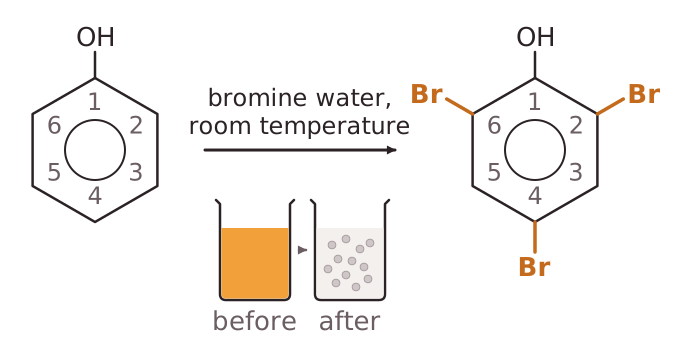 Observations:
• the orange bromine water is decolourised
• a white precipitate of 2,4,6-tribromophenol forms, because it is insoluble in water; it has an antiseptic smellThis is an electrophilic substitution, like the bromination of benzene, but it happens far more easily. Compare the conditions:
• benzene: pure liquid bromine and a halogen carrier (FeBr3), only one Br substituted
• phenol: dilute bromine water, no catalyst, room temperature, three Br substituted
The OH group makes the ring much more reactive; the reason is explained in the next lesson.The reaction is used as a test for phenol. Alkenes also decolourise bromine water, but they do not give a white precipitate, and benzene does not decolourise bromine water at all.Worked example: 0.940 g of phenol (Mr = 94.0) reacts with excess bromine water. Amount of phenol = 0.940 ÷ 94.0 = 0.0100 mol. The ratio is 1 : 3, so 0.0300 mol of Br2 reacts. 2,4,6-tribromophenol has Mr = 331, so the mass of precipitate is 0.0100 × 331 = 3.31 g.
Observations:• the orange bromine water is decolourised
• a white precipitate of 2,4,6-tribromophenol forms, because it is insoluble in water; it has an antiseptic smellThis is an electrophilic substitution, like the bromination of benzene, but it happens far more easily. Compare the conditions:
• benzene: pure liquid bromine and a halogen carrier (FeBr3), only one Br substituted
• phenol: dilute bromine water, no catalyst, room temperature, three Br substituted
The OH group makes the ring much more reactive; the reason is explained in the next lesson.The reaction is used as a test for phenol. Alkenes also decolourise bromine water, but they do not give a white precipitate, and benzene does not decolourise bromine water at all.Worked example: 0.940 g of phenol (Mr = 94.0) reacts with excess bromine water. Amount of phenol = 0.940 ÷ 94.0 = 0.0100 mol. The ratio is 1 : 3, so 0.0300 mol of Br2 reacts. 2,4,6-tribromophenol has Mr = 331, so the mass of precipitate is 0.0100 × 331 = 3.31 g.