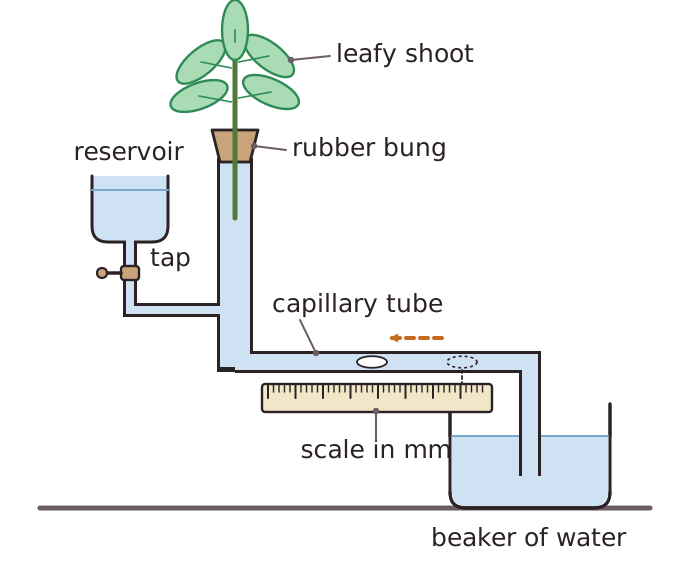
A potometer measures the rate of water uptake by a plant shoot. Cut the shoot under water so that no air gets into the xylem, then fit it into the apparatus, which is full of water, with airtight joints. Place the open end of the capillary tube in a beaker of water and let one air bubble in. As the shoot takes up water, the bubble moves along the scale. Use the bubble to measure how far the water has moved in a set time.
The rate is the distance the bubble moves divided by the time taken. For example, a bubble that moves 30 mm in 5 minutes gives a rate of 6 mm per minute. The volume of water taken up can be found from the distance moved and the cross-sectional area of the capillary tube. Divide the volume by the time to give a rate in volume of water per unit time.
To investigate a factor, such as light intensity, air movement or temperature, change only that one factor and keep the others the same. Repeat each reading and find a mean. Reset the bubble by using the reservoir tap between readings. A potometer actually measures water uptake, which is assumed to be the same as transpiration.
You can also measure the mass of a plant cutting at the start and end of an experiment. Percentage change in mass = change in mass ÷ starting mass × 100. A cutting that goes from 20.0 g to 18.0 g has lost 2.0 g, which is a 10% loss.