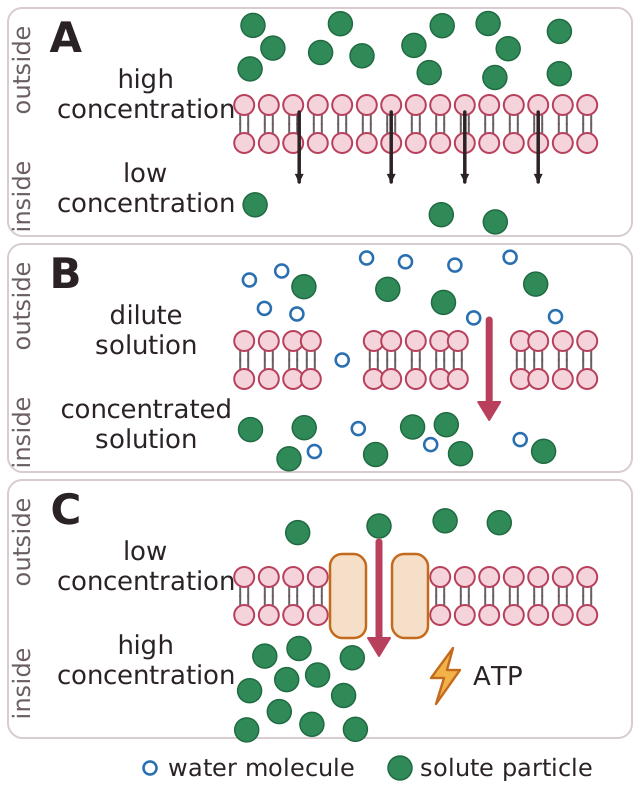
Cells must take in substances such as oxygen and glucose and remove waste such as carbon dioxide and urea. These substances cross the cell membrane in three ways.
Diffusion is the net movement of particles from a region of higher concentration to a region of lower concentration. The particles move down a concentration gradient, and no energy from the cell is needed. Oxygen diffuses into cells and carbon dioxide and urea diffuse out. The steeper the concentration gradient, the faster the diffusion.
Osmosis is the diffusion of water across a partially permeable membrane. Water moves from a region of higher water potential (a dilute solution) to a region of lower water potential (a concentrated solution). If a plant cell is placed in a very concentrated sugar solution it loses water by osmosis and its mass falls. In a dilute solution it gains water and its mass rises.
Active transport moves substances from a region of lower concentration to a region of higher concentration, which is against the concentration gradient. This needs energy from respiration. Root hair cells use it to take up mineral ions from the soil, and cells in the gut use it to absorb glucose.