When light is the limiting factor, the rate of photosynthesis is directly proportional to light intensity. Double the light intensity and the rate doubles.
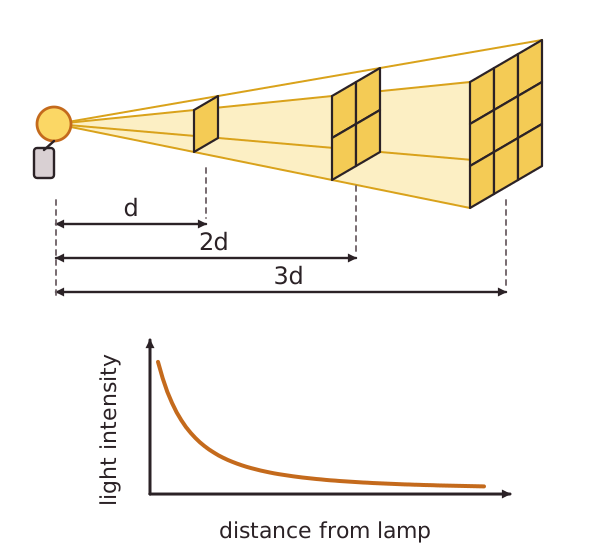
Light spreads out as it travels from a lamp, so the light intensity falls quickly with distance. It follows the inverse square law: light intensity is inversely proportional to the square of the distance from the lamp, which is written as intensity ∝ 1/d2. Doubling the distance makes the intensity one quarter. Halving the distance makes the intensity four times greater. Three times the distance gives one ninth of the intensity. In words, intensity is proportional to one divided by the distance squared.
Putting the two ideas together, the rate of photosynthesis is also proportional to 1/d2. For example, pondweed 10 cm from a lamp makes 20 bubbles per minute. At 20 cm the distance is doubled, so the rate falls to one quarter, which is 5 bubbles per minute. At 5 cm the distance is halved, so the rate is four times greater, which would be 80 bubbles per minute. Likewise, 12 bubbles per minute at 30 cm becomes 48 at 15 cm. A graph of rate against 1/d2 is a straight line through the origin.
This only works while light is the limiting factor. If carbon dioxide or temperature is limiting, moving the lamp closer will not raise the rate.