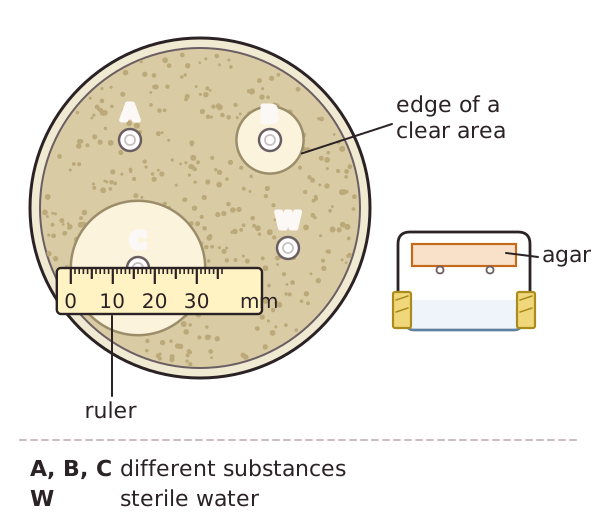
This practical tests how well different substances stop bacteria growing. Using aseptic technique, a sterile loop or spreader is used to cover the surface of a sterile agar plate with a layer of bacteria, called a lawn. Small paper discs are soaked in the different antiseptics, antibiotics or plant extracts and placed on the lawn with sterile forceps. One disc is soaked in sterile water only. This is the control, and it shows that any effect is caused by the substance and not by the disc or the water.
The lid is taped on, the dish is turned upside down so condensation does not drip onto the agar, and it is incubated for about two days. School cultures are kept at about 25 °C, which is low enough to avoid growing pathogens that thrive at body temperature. Afterwards the dish is not opened.
If a substance stops the bacteria growing, a clear area with no bacteria forms around its disc. This is the inhibition zone. The larger the clear zone, the more effective the substance is. The diameter of each zone is measured with a ruler. The independent variable is the type of substance on the disc and the dependent variable is the diameter of the clear zone. To make the test fair, the same bacterium, the same volume of agar, discs of the same size, the same amount of each substance, and the same incubation time and temperature must be used for every disc.