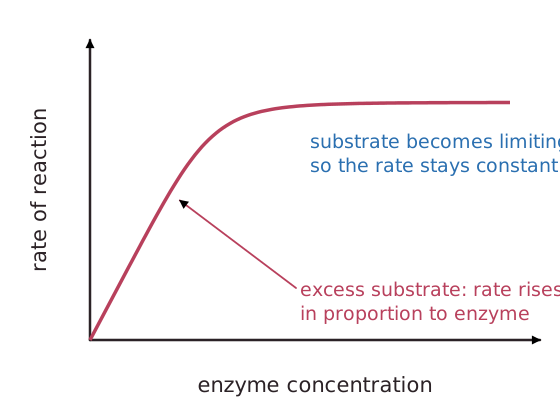
Enzymes are biological catalysts. This means they are not used up in the reaction and can be re-used when the reaction is complete and the products have been released from the enzyme's active site.In this way one enzyme can catalyse millions of reactions and act on millions of substrate molecules.As long as there is excess substrate the rate of reaction is directly proportional to the concentration of enzyme.There are more active sites available so more enzyme-substrate complexes can be formed.At high enzyme concentrations, the substrate concentration becomes limiting.The substrate molecules are being used up rapidly so the rate of reaction remains constant.