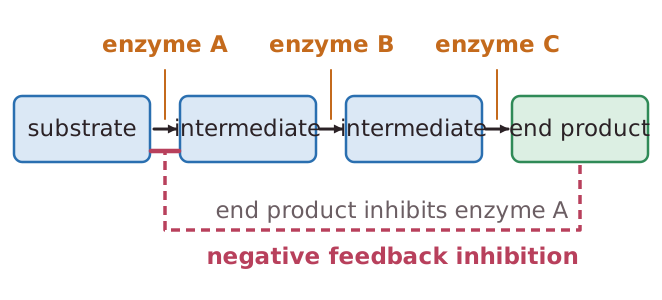
End-product inhibition is used to control the level of the final product in a metabolic pathway.A metabolic pathway is a series of enzyme catalysed reactions in which the product of one reaction is the substrate of another.The enzymes may be attached to a membrane in an organelle in the same order as the series of reactions.The last product in the pathway inhibits the first enzyme or an enzyme early on in the pathway so the amount of product formed is reduced.End product inhibition is usually non-competitive. It is a way of regulating the amount of product formed.If there is sufficient product the excess product inhibits the enzyme and switches off its production.End-product inhibition is an example of negative feedback control.