Skip to content

The Cell Cycle

Cells undergo a regular cycle of growth and division.The Cell undergoes a repeated cycle of interphase, mitosis and cytokinesis.The cell cycles for different cells have different lengths.Some cells replicate often others do not replicate or have a very long cell cycle.The more differentiated the cell, the longer the cell cycle.
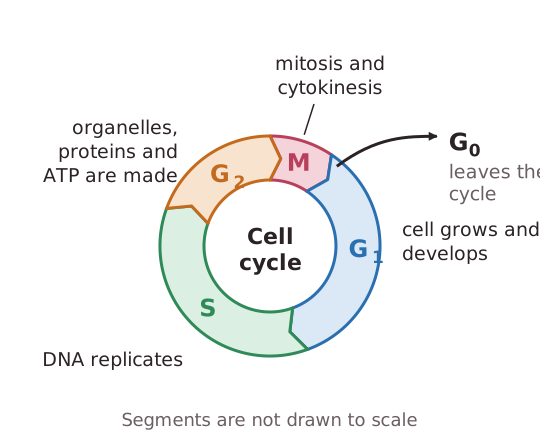
During Interphase the cell grows and carries out its normal functions and DNA is replicated.The cell continues to increases in size and synthesise proteins and mitochondria replicate.Nuclear division (mitosis) then takes place followed by cytokinesis which produces two separate cells.The cell enters the G0 phase when it leaves the cell cycle temporarily or permanently because of damage, senescence or differentiation.

Read the text

Read the text and highlight anything you think is important. When you go on, the text is hidden and you answer from memory.

Specification: OCR Biology A (H020), AS-level, 2.1.6 Cell division, cell diversity and cellular organisation. Topic: Cell Division.

Key terms in this lesson

mitochondrion
An organelle with a double membrane, the inner one folded into cristae, that is the site of aerobic respiration and ATP production.
mitosis
Nuclear division producing two daughter nuclei that are genetically identical to the parent nucleus, used in growth, repair and asexual reproduction.

More in Cell Division

All 31 lessons in Cell Division · All OCR AS-level Biology topics