Skip to content

Interphase

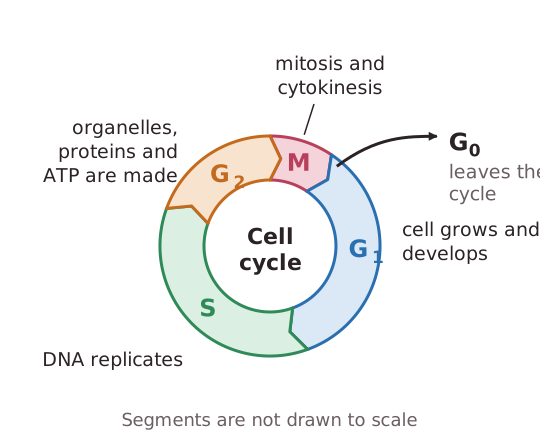
During interphase, the cell grows and carries out various metabolic processes. There are three main stages of Interphase:G1 - During the gap1 phase the cell assimilates new material, grows and develops. This can take hours, days, months or years.S - When the cell divides half the genetic material goes to each cell, so the DNA must be doubled to maintain the same amount of genetic material. DNA replication occurs during this phase. Each strand is copied so the chromosomes are now made of two identical chromatids held together by a centromere.G2 - During the gap2 phase, organelles such as mitochondria and proteins and ATP needed for cell division are synthesised. Prior to mitosis, the nucleus consists of loosely coiled chromatin - DNA strands loosely wound round histone proteins. Individual chromosomes cannot yet be seen.
Read the text

Read the text and highlight anything you think is important. When you go on, the text is hidden and you answer from memory.

Specification: OCR Biology A (H020), AS-level, 2.1.6 Cell division, cell diversity and cellular organisation. Topic: Cell Division.

Key terms in this lesson

organelle
A membrane-bound structure within a cell with a specific structure suited to a specific function.
mitochondrion
An organelle with a double membrane, the inner one folded into cristae, that is the site of aerobic respiration and ATP production.
chromatin
The complex of DNA loosely coiled around histone proteins found in the nucleus between cell divisions.
ATP
Adenosine triphosphate, a nucleotide that acts as the immediate energy source of a cell, releasing energy when hydrolysed to ADP and inorganic phosphate.
mitosis
Nuclear division producing two daughter nuclei that are genetically identical to the parent nucleus, used in growth, repair and asexual reproduction.

More in Cell Division

All 31 lessons in Cell Division · All OCR AS-level Biology topics