Skip to content

Osmosis in Plant Cells

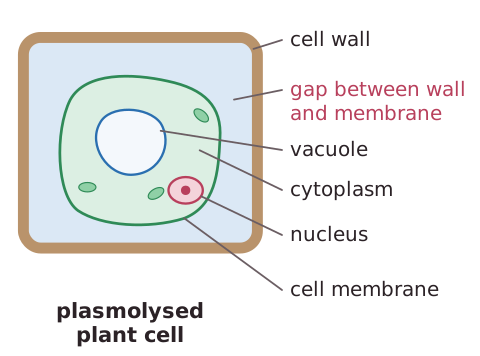
Plant cells contain various solutes in the cytoplasm.Some of the solutes are dissolved in the large central vacuole.Some plant cells are normally in a medium of almost pure water.Because the cell wall is unable to expand to any great extent, water moves into the plant by osmosis and presses against the inside of the cell wall.This pressure, called turgor pressure, resists the further entry of water molecules into the cell. The cell is said to be turgid.If a plant cell is placed in a medium with lower water potential, water leaves the cell by osmosis.The protoplast (cell membrane, cytoplasm and cell contents) pulls away from the cellulose cell wall and the cell become plasmolysed.
Read the text

Read the text and highlight anything you think is important. When you go on, the text is hidden and you answer from memory.

Specification: OCR Biology A (H020), AS-level, 2.1.5 Biological membranes. Topic: Plasma Membrane.

Key terms in this lesson

osmosis
The net movement of water molecules from a region of higher water potential to a region of lower water potential through a selectively permeable membrane.
water potential
A measure of the tendency of water molecules to move out of a solution; pure water has a water potential of zero and adding solute lowers it.

More in Plasma Membrane

All 18 lessons in Plasma Membrane · All OCR AS-level Biology topics