Telophase is the last stage of nuclear division in mitosis. It begins when the chromatids, now called chromosomes, reach the poles of the cell.The spindle apparatus breaks down as the spindle microtubules are depolymerised. A nuclear envelope reforms around each set of chromosomes, forming two new nuclei.The chromosomes uncoil and decondense back into the loosely coiled chromatin found in interphase, and a nucleolus reappears in each nucleus. The events of prophase are effectively reversed.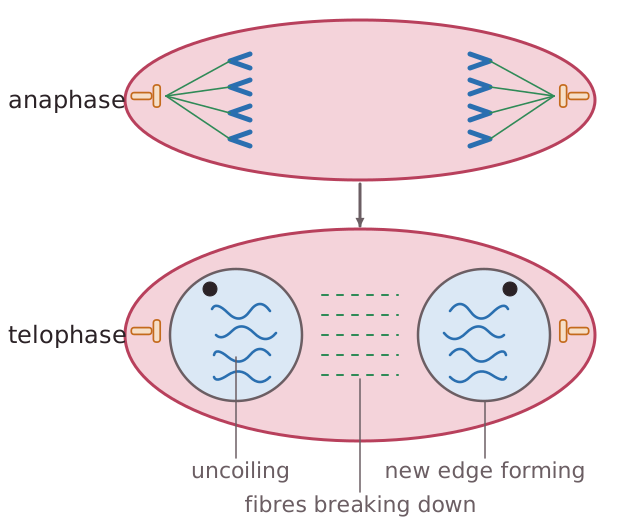 The two nuclei are genetically identical to each other and to the original nucleus, and each has the same number of chromosomes.Telophase marks the end of nuclear division. The division of the cytoplasm usually begins before telophase has finished.