Skip to content

Test for Lipids

Lipids such as triglycerides are non-polar, so they are insoluble in water but dissolve in organic solvents such as ethanol. The emulsion test uses this difference in solubility.The test for lipids is called the ethanol emulsion test. 5cm3 of ethanol is added to 2cm3 of sample.Shake thoroughly to dissolve any lipid in the sample. Add 5cm3 of water. A cloudy white emulsion indicates the presence of lipid.
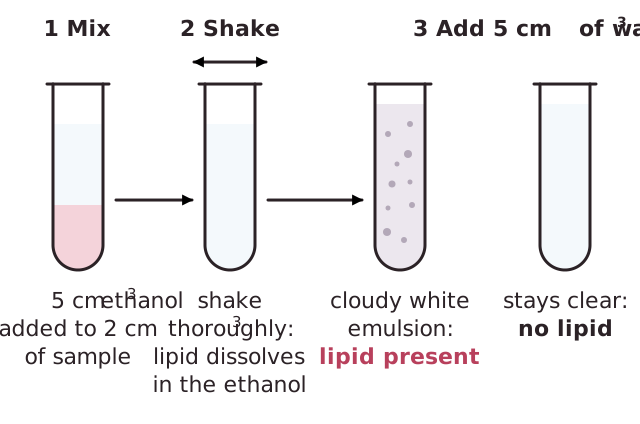
The 5cm3 added first is ethanol. The lipid must dissolve in the ethanol before any water is added.When water is added, the ethanol mixes with it because ethanol is miscible with water. The lipid is insoluble in water, so it comes out of solution as tiny droplets spread through the liquid. This is an emulsion: a mixture of two liquids that do not dissolve in each other, with droplets of one scattered throughout the other. The droplets scatter light, so the mixture looks milky.If no lipid is present, the mixture stays clear. The test is qualitative: it shows whether lipid is present, not how much. Ethanol is flammable, so keep it away from naked flames.

Read the text

Read the text and highlight anything you think is important. When you go on, the text is hidden and you answer from memory.