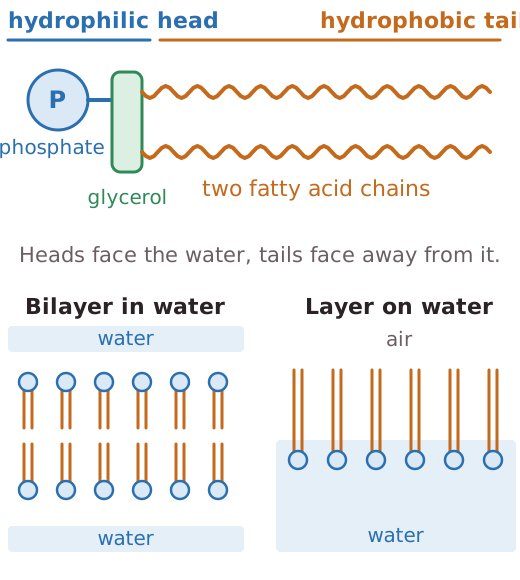
Phospholipids contain the elements carbon hydrogen, oxygen and phosphorus.Negatively charged inorganic phosphate ions PO43- are found dissolved in the cytoplasm of cells.Phospholipids are similar to lipids except that one of the fatty acids is replaced by a phosphate group.The phosphate molecules are hydrophilic (attract water) and the fatty acids repel water (hydrophobic). A phospholipid therefore has a hydrophilic head and a hydrophobic tail.The molecule is said to be polar.Phospholipids are surfactants or surface-active agents.When added to water they form a layer on the surface with the phosphate group in contact with the water and hydrophobic tails sticking up out of the water.Surfactants reduce the surface tension of liquids increasing its spreading and wetting properties.Phospholipids can also form a bilayer when added to water with the hydrophobic tails of both layers pointing inwards towards the centre of the bilayer.Cells exist in aqueous environments so phospholipids bilayers are ideal for the formation of cell membranes and membranes of organelles.