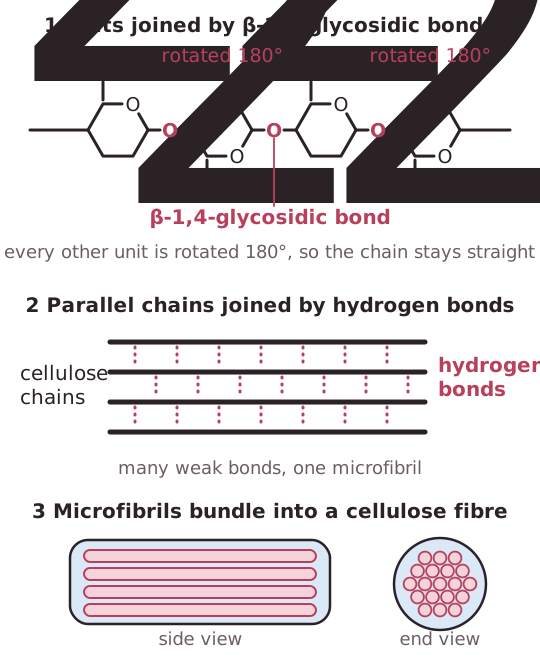
Cellulose is a polysaccharide made from beta-glucose. Beta glucose is an isomer of alpha-glucose with the hydroxyl group on carbon atom 1 above rather than below the ring.This means that the hydroxyl groups of carbon atom 1 and carbon atom 4 are too far from each other to react. As a result every other glucose molecule has to be rotated by 180° to bring the hydroxyl groups close enough to react and form a beta-1,4-glycosidic bond.The polysaccharide formed is unable to coil or rotate so forms a straight chain.The straight chain molecules form hydrogen bonds with each other and bundle together to form cellulose microfibrils.The microfibrils in turn form hydrogen bonds and bundles of microfibrils form cellulose macrofibrils which combine to form cellulose fibres.Cellulose fibres are strong and insoluble and are the material used for plant cell walls.