Colorimetry can be used as a quantitative method to determine concentrations.If Benedicts solution is added to a solution of reducing sugar the blue copper(II) sulfate is reduced to insoluble copper(I) oxide and an orange-red precipitate forms.The solution loses its colour and becomes less blue because there is less copper sulfate.The concentration of copper sulfate remaining can be determined by colorimetry.The more concentrated a solution is the more light it will absorb.The procedure to determine the concentration of glucose is as follows: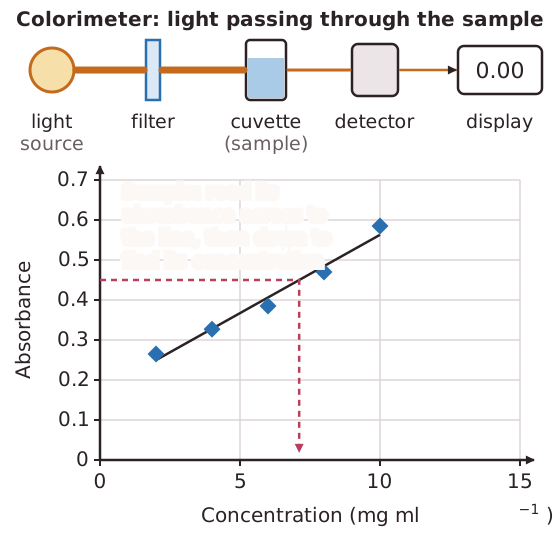
- A red filter is placed in the colorimeter.
- A cuvette filled with distilled water is placed in the colorimeter and it is set to zero.
- Benedict's test is performed on a range of known concentration of glucose.
- The solutions are filtered to remove the precipitate.
- The absorbance (or percentage transmission) of each filtrate is measured using the colorimeter.
- The results are used to plot a calibration curve.