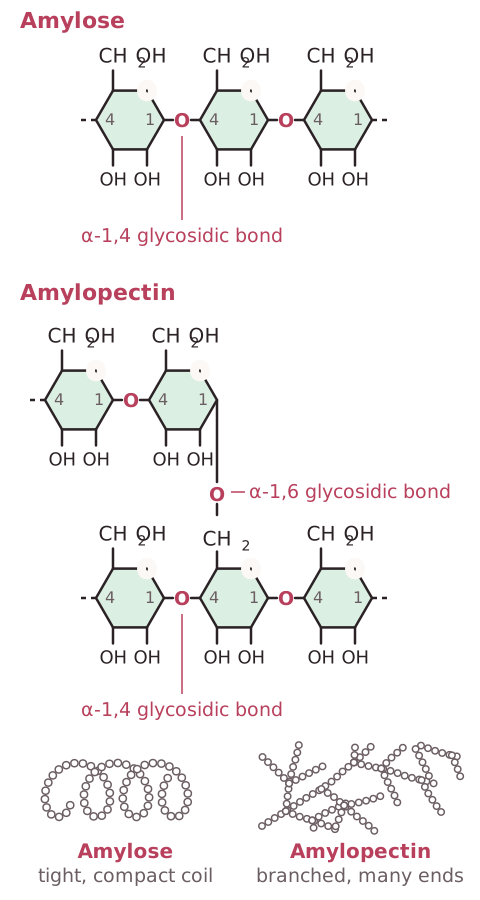
Starch is an energy storage polysaccharide found in plants. Starch grains occur in seeds and storage organs such as potato tubers.Starch is made of chains of alpha glucose monosaccharides linked by glycosidic bonds.Starch is made of amylose and amylopectin.Amylose is unbranched. The glucose molecules are joined by α-1,4-glycosidic bonds. Unbranched chains are wound into tight, compact coils.Amylopectin is branched. The glucose molecules form branches by α-1,6-glycosidic bonds.Starch is used by plants to store energy.It is insoluble so does not affect the water potential of cells.It is large so cannot diffuse out of cells.It is compact so a lot can be stored in a small space.It is easily hydrolysed to α-glucose which can be used in respiration.The branched form has many ends which can be acted upon by many enzymes simultaneously to rapidly release α-glucose.