 BRAINCAKE
Triglycerides
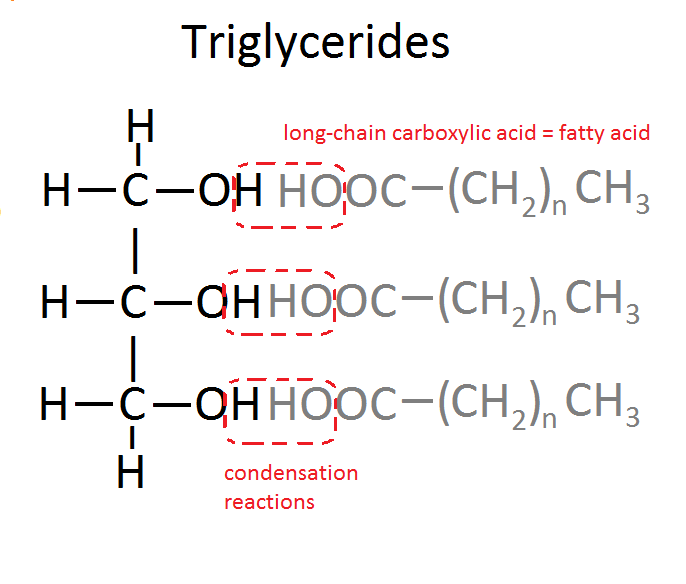
Triglycerides consist of three fatty acids joined to a glycerol molecule by three ester bonds in a condensation reaction.
Glycerol is an alcohol (propan-1,2,3-triol. Fatty acids are long-chain carboxylic acids.
Different triglycerides have different properties because they contain different fatty acids.
Sign in free to see the rest of this lesson, the R.E.C.I.P.E. recall steps and the quiz
BrainCake is free. Make an account in seconds and pick up where this page stops.
Key terms in this lesson
- condensation reaction
- A reaction that joins two molecules together with a covalent bond, releasing a water molecule.
- water potential
- A measure of the tendency of water molecules to move out of a solution; pure water has a water potential of zero and adding solute lowers it.
More in Biological Molecules
- Glycogen
- Cellulose
- Biosensors
- Lipids
- Saturated and Unsaturated Fatty Acids
- Phospholipids
- Sterols
- Roles of Lipids
All 63 lessons in Biological Molecules · All OCR AS-level Biology topics