Xylem tissue contains several cell types: xylem vessels, which carry water, tracheids, fibres, which give support, and parenchyma, which stores food. The vessels are the main route for water and mineral ions.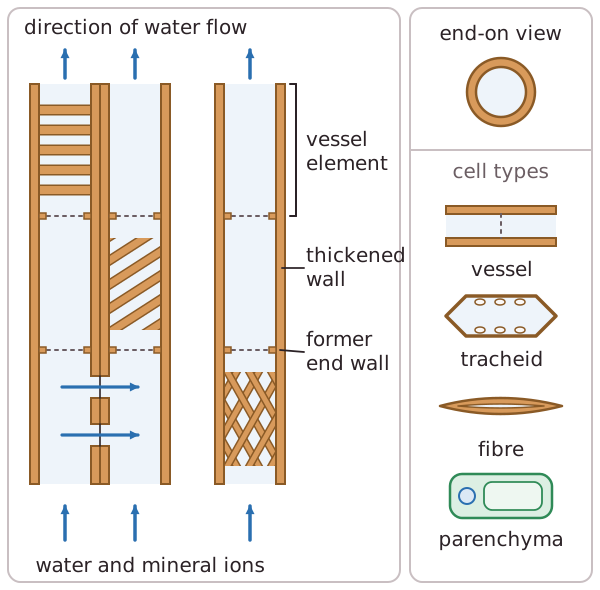 Each xylem vessel develops from a column of cells called vessel elements. As they mature, several changes adapt them to their function:1. The walls are thickened with lignin. Lignin is strong and waterproof, and it stops the vessels collapsing under the tension created as water is pulled up the plant.
2. The cells die and lose their contents, so there is no cytoplasm to slow the flow of water.
3. The end walls break down, so the vessel elements join to form a long, continuous, hollow tube. With no cytoplasm or end walls, there is little resistance to the flow of water.The lignin is laid down in patterns, such as rings (annular), spirals or a network. These patterns allow the stem to stay flexible and to grow in length.In places, the lignin is absent, leaving pits. Pits allow water and mineral ions to move sideways between neighbouring vessels and out to the surrounding tissues. They also let water bypass a vessel that has become blocked by an air bubble.Xylem vessels are narrow, which helps the water column to be held up by adhesion to the walls.
Each xylem vessel develops from a column of cells called vessel elements. As they mature, several changes adapt them to their function:1. The walls are thickened with lignin. Lignin is strong and waterproof, and it stops the vessels collapsing under the tension created as water is pulled up the plant.2. The cells die and lose their contents, so there is no cytoplasm to slow the flow of water.
3. The end walls break down, so the vessel elements join to form a long, continuous, hollow tube. With no cytoplasm or end walls, there is little resistance to the flow of water.The lignin is laid down in patterns, such as rings (annular), spirals or a network. These patterns allow the stem to stay flexible and to grow in length.In places, the lignin is absent, leaving pits. Pits allow water and mineral ions to move sideways between neighbouring vessels and out to the surrounding tissues. They also let water bypass a vessel that has become blocked by an air bubble.Xylem vessels are narrow, which helps the water column to be held up by adhesion to the walls.