Several simple experiments show that water moves up the plant through the xylem, and that it is pulled up under tension.Dye experiments. If a cut celery stalk or a white flower is placed in water containing a coloured dye such as eosin, the dye moves up the stem. When a thin cross-section of the stem is cut and viewed, only the xylem is stained. This shows that water travels in the xylem.Ringing experiments. If a ring of bark is removed from a woody stem, the phloem is removed but the xylem, which lies deeper, is left intact. The leaves above the ring do not wilt, so water must still be moving up through the xylem.Evidence that the water is under tension:1. When a xylem vessel is cut, air is drawn into it rather than water leaking out. The water inside must be under tension (negative pressure).
2. The diameter of a tree trunk decreases slightly during the day, when the rate of transpiration is highest. The tension pulls the xylem walls inwards. At night, when transpiration is low, the trunk widens again.
3. If air enters the xylem, the water column is broken and water stops moving up that vessel. This shows that water moves as a continuous column.This evidence supports the cohesion-tension theory of water movement.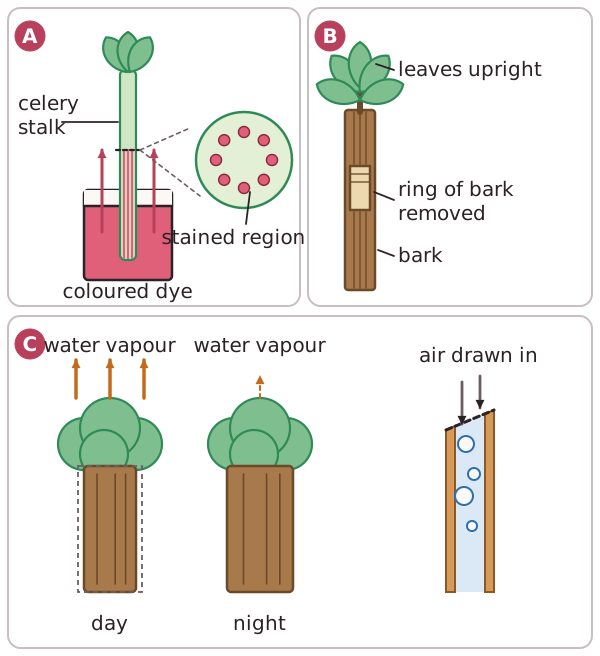
2. The diameter of a tree trunk decreases slightly during the day, when the rate of transpiration is highest. The tension pulls the xylem walls inwards. At night, when transpiration is low, the trunk widens again.
3. If air enters the xylem, the water column is broken and water stops moving up that vessel. This shows that water moves as a continuous column.This evidence supports the cohesion-tension theory of water movement.