Water and mineral ions enter the plant through root hair cells. A root hair is a long, thin extension of a root epidermal cell, found just behind the growing root tip.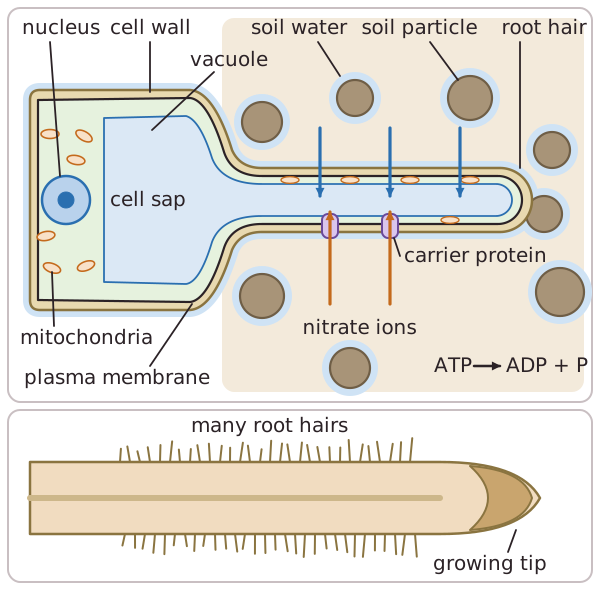 Root hair cells are adapted for absorption:1. Each root has thousands of root hairs, giving a very large surface area in contact with the soil water.
2. The hairs are thin, so the distance water travels into the cell is short.
3. The cells contain many mitochondria to supply ATP for active transport.Water uptake. Soil water is a dilute solution with a high (less negative) water potential. The cell sap of the root hair contains dissolved sugars and ions, so it has a lower water potential. Water therefore moves into the root hair cell by osmosis, down the water potential gradient, through the partially permeable plasma membrane.Mineral ion uptake. Ions such as nitrate and potassium are usually at a higher concentration in the cell than in the soil. They are absorbed against their concentration gradient by active transport, using carrier proteins and ATP. Taking in ions also lowers the water potential of the cell, helping more water to enter by osmosis.If the soil water becomes very salty, its water potential falls below that of the cell and water leaves the root hair, so the plant wilts.
Root hair cells are adapted for absorption:1. Each root has thousands of root hairs, giving a very large surface area in contact with the soil water.2. The hairs are thin, so the distance water travels into the cell is short.
3. The cells contain many mitochondria to supply ATP for active transport.Water uptake. Soil water is a dilute solution with a high (less negative) water potential. The cell sap of the root hair contains dissolved sugars and ions, so it has a lower water potential. Water therefore moves into the root hair cell by osmosis, down the water potential gradient, through the partially permeable plasma membrane.Mineral ion uptake. Ions such as nitrate and potassium are usually at a higher concentration in the cell than in the soil. They are absorbed against their concentration gradient by active transport, using carrier proteins and ATP. Taking in ions also lowers the water potential of the cell, helping more water to enter by osmosis.If the soil water becomes very salty, its water potential falls below that of the cell and water leaves the root hair, so the plant wilts.