After entering the root hair, water must cross the cortex of the root to reach the xylem in the centre. It can take two routes. This lesson covers the symplast pathway.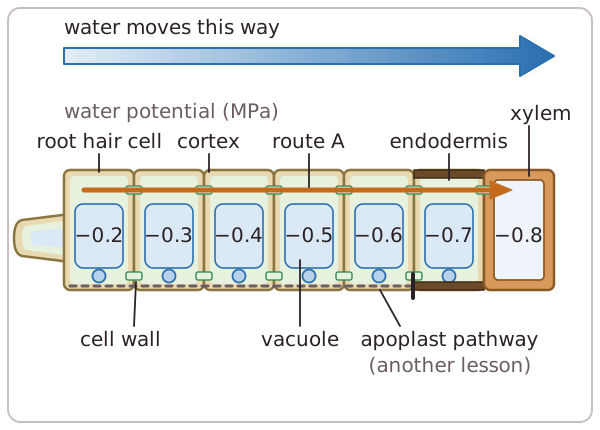 The symplast is the continuous system of cytoplasm in the plant. The cytoplasm of neighbouring cells is joined by plasmodesmata, strands of cytoplasm that pass through channels in the cell walls.In the symplast pathway, water moves through the cytoplasm of one cell, through the plasmodesmata and into the cytoplasm of the next cell. The movement is by osmosis:1. Water entering the root hair cell raises its water potential.
2. The neighbouring cortex cell now has a lower water potential, so water moves into it by osmosis.
3. This is repeated across the cortex, so there is a water potential gradient from the root hair towards the xylem.Water may also pass through the vacuoles of the cells as well as the cytoplasm. This is sometimes called the vacuolar pathway.Because water has to cross plasma membranes and pass through cytoplasm, the symplast pathway is slower than the apoplast pathway, and it carries less of the water. However, the plasma membrane gives the plant control over which substances enter the living cells. At the endodermis, all water must enter the symplast before it reaches the xylem.
The symplast is the continuous system of cytoplasm in the plant. The cytoplasm of neighbouring cells is joined by plasmodesmata, strands of cytoplasm that pass through channels in the cell walls.In the symplast pathway, water moves through the cytoplasm of one cell, through the plasmodesmata and into the cytoplasm of the next cell. The movement is by osmosis:1. Water entering the root hair cell raises its water potential.2. The neighbouring cortex cell now has a lower water potential, so water moves into it by osmosis.
3. This is repeated across the cortex, so there is a water potential gradient from the root hair towards the xylem.Water may also pass through the vacuoles of the cells as well as the cytoplasm. This is sometimes called the vacuolar pathway.Because water has to cross plasma membranes and pass through cytoplasm, the symplast pathway is slower than the apoplast pathway, and it carries less of the water. However, the plasma membrane gives the plant control over which substances enter the living cells. At the endodermis, all water must enter the symplast before it reaches the xylem.