Transpiration is the loss of water vapour from the aerial parts of a plant, mainly from the leaves. Most of it is lost through the stomata, small pores in the leaf epidermis, with a small amount lost through the waxy cuticle.The process happens in three stages:1. Water moves from the xylem in the veins into the mesophyll cells and their cell walls.
2. Water evaporates from the surfaces of the cell walls of the spongy mesophyll cells into the air spaces inside the leaf. The air spaces become saturated with water vapour.
3. The air outside the leaf usually has a lower concentration of water vapour. Water vapour therefore diffuses out of the leaf through the open stomata, down this water vapour concentration gradient.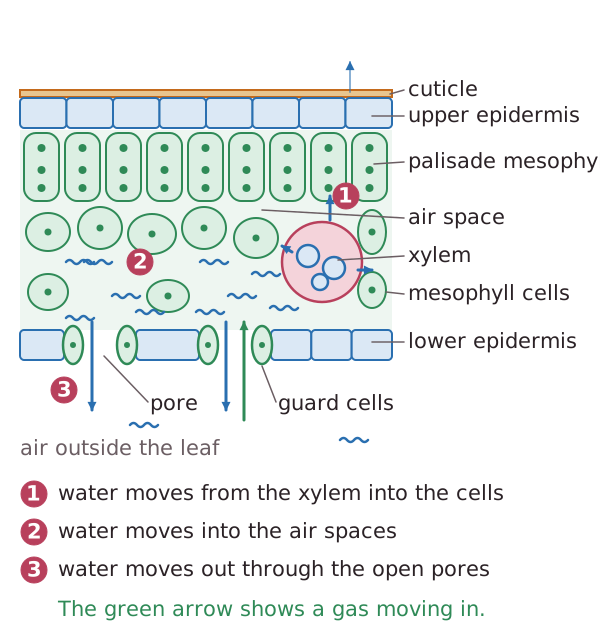 Transpiration is an unavoidable consequence of gas exchange. The stomata must open during the day to let carbon dioxide diffuse in for photosynthesis, and when they are open water vapour diffuses out. Guard cells can close the stomata to reduce water loss, but this also stops carbon dioxide uptake.Transpiration also has benefits for the plant. It creates the transpiration stream, the flow of water up the xylem from roots to leaves, which carries mineral ions to where they are needed. Evaporation also cools the leaves, and the water supplied keeps cells turgid.
2. Water evaporates from the surfaces of the cell walls of the spongy mesophyll cells into the air spaces inside the leaf. The air spaces become saturated with water vapour.
3. The air outside the leaf usually has a lower concentration of water vapour. Water vapour therefore diffuses out of the leaf through the open stomata, down this water vapour concentration gradient.
Transpiration is an unavoidable consequence of gas exchange. The stomata must open during the day to let carbon dioxide diffuse in for photosynthesis, and when they are open water vapour diffuses out. Guard cells can close the stomata to reduce water loss, but this also stops carbon dioxide uptake.Transpiration also has benefits for the plant. It creates the transpiration stream, the flow of water up the xylem from roots to leaves, which carries mineral ions to where they are needed. Evaporation also cools the leaves, and the water supplied keeps cells turgid.