As well as being attracted to each other (cohesion), water molecules are attracted to other substances. This is called adhesion.The walls of xylem vessels contain cellulose, which is hydrophilic. Water molecules form hydrogen bonds with the cellulose, so water adheres to the vessel walls. Adhesion helps the water column to cling to the walls, supporting it against the pull of gravity and helping to stop the column breaking away from the walls.Capillarity is the rise of water up a narrow tube. It happens because of adhesion and cohesion working together:1. Water molecules at the edge adhere to the wall of the tube and creep upwards.
2. Cohesion means these molecules pull other water molecules up with them.
3. Water continues to rise until the weight of the column balances the upward pull.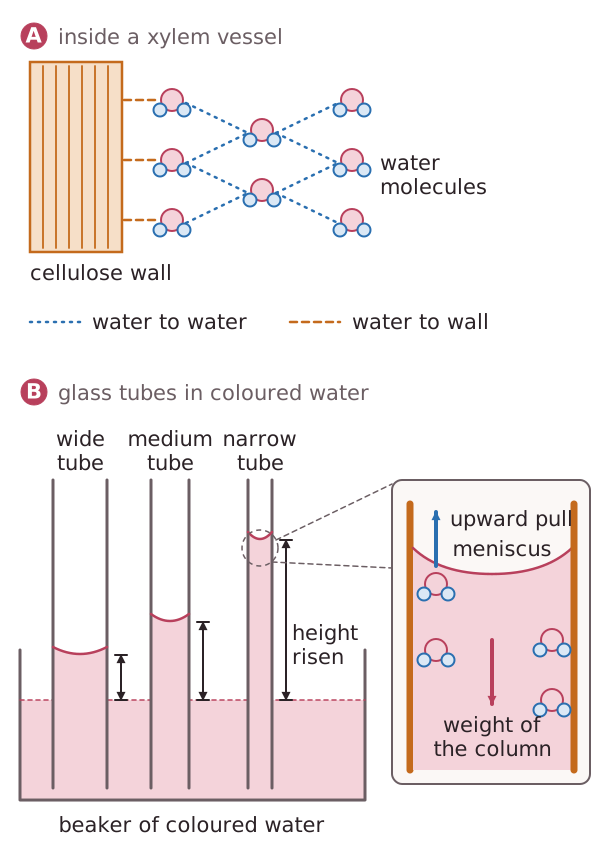 The narrower the tube, the higher the water rises, because a greater proportion of the water is in contact with the walls. This can be shown by standing glass capillary tubes of different diameters in coloured water.Xylem vessels are very narrow, so capillarity helps water to move up them. However, capillarity can only raise water a small distance. It cannot on its own explain how water reaches the top of tall trees; this depends mainly on the cohesion-tension mechanism.
2. Cohesion means these molecules pull other water molecules up with them.
3. Water continues to rise until the weight of the column balances the upward pull.
The narrower the tube, the higher the water rises, because a greater proportion of the water is in contact with the walls. This can be shown by standing glass capillary tubes of different diameters in coloured water.Xylem vessels are very narrow, so capillarity helps water to move up them. However, capillarity can only raise water a small distance. It cannot on its own explain how water reaches the top of tall trees; this depends mainly on the cohesion-tension mechanism.