Prophase is the first stage of mitosis. It follows G2 of interphase, so the DNA has already been replicated.The main events of prophase are:• Chromosomes condense. The chromatin coils up tightly, so the chromosomes become shorter and thicker and can be seen with a light microscope. Each chromosome is now visible as two sister chromatids joined at the centromere.
• The nucleolus disappears.
• The spindle forms. In animal cells, the two centrioles (which were replicated during interphase) move to opposite poles of the cell. Protein microtubules grow out from them to form the spindle fibres. Plant cells have no centrioles, but still form a spindle from microtubule-organising regions.
• The nuclear envelope breaks down at the end of prophase, releasing the chromosomes into the cytoplasm, so the spindle fibres can reach them.At the end of prophase, spindle fibres start to attach to the centromeres of the chromosomes, ready for metaphase.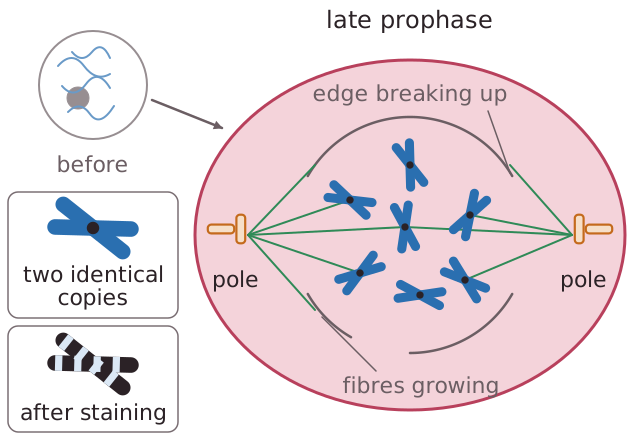 Prophase is usually the longest stage of mitosis, so in a root tip squash more dividing cells are normally seen in prophase than in any other stage.To identify prophase in a micrograph, look for: visible, thread-like chromosomes that are scattered (not lined up), and either a nuclear envelope still partly present or no clear arrangement of chromosomes yet.
• The nucleolus disappears.
• The spindle forms. In animal cells, the two centrioles (which were replicated during interphase) move to opposite poles of the cell. Protein microtubules grow out from them to form the spindle fibres. Plant cells have no centrioles, but still form a spindle from microtubule-organising regions.
• The nuclear envelope breaks down at the end of prophase, releasing the chromosomes into the cytoplasm, so the spindle fibres can reach them.At the end of prophase, spindle fibres start to attach to the centromeres of the chromosomes, ready for metaphase.
Prophase is usually the longest stage of mitosis, so in a root tip squash more dividing cells are normally seen in prophase than in any other stage.To identify prophase in a micrograph, look for: visible, thread-like chromosomes that are scattered (not lined up), and either a nuclear envelope still partly present or no clear arrangement of chromosomes yet.